

Tax Calculator (US Federal, 2026)
Marginal rate: 22%
Effective rate: 13.17% of gross income
Direct answer: Federal tax is computed bracket by bracket: only the income inside each bracket is taxed at that bracket’s rate. A single filer earning $100,000 with the $16,100 standard deduction has $83,900 of taxable income and owes about $13,170 — a 22% marginal rate but only a 13.17% effective rate.
2026 federal brackets used here
| Rate | Single — taxable income up to | Married filing jointly — up to | Married filing separately — up to |
|---|---|---|---|
| 10% | $12,400 | $24,800 | $12,400 |
| 12% | $50,400 | $100,800 | $50,400 |
| 22% | $105,700 | $211,400 | $105,700 |
| 24% | $201,775 | $403,550 | $201,775 |
| 32% | $256,225 | $512,450 | $256,225 |
| 35% | $640,600 | $768,700 | $384,350 |
| 37% | above $640,600 | above $768,700 | above $384,350 |
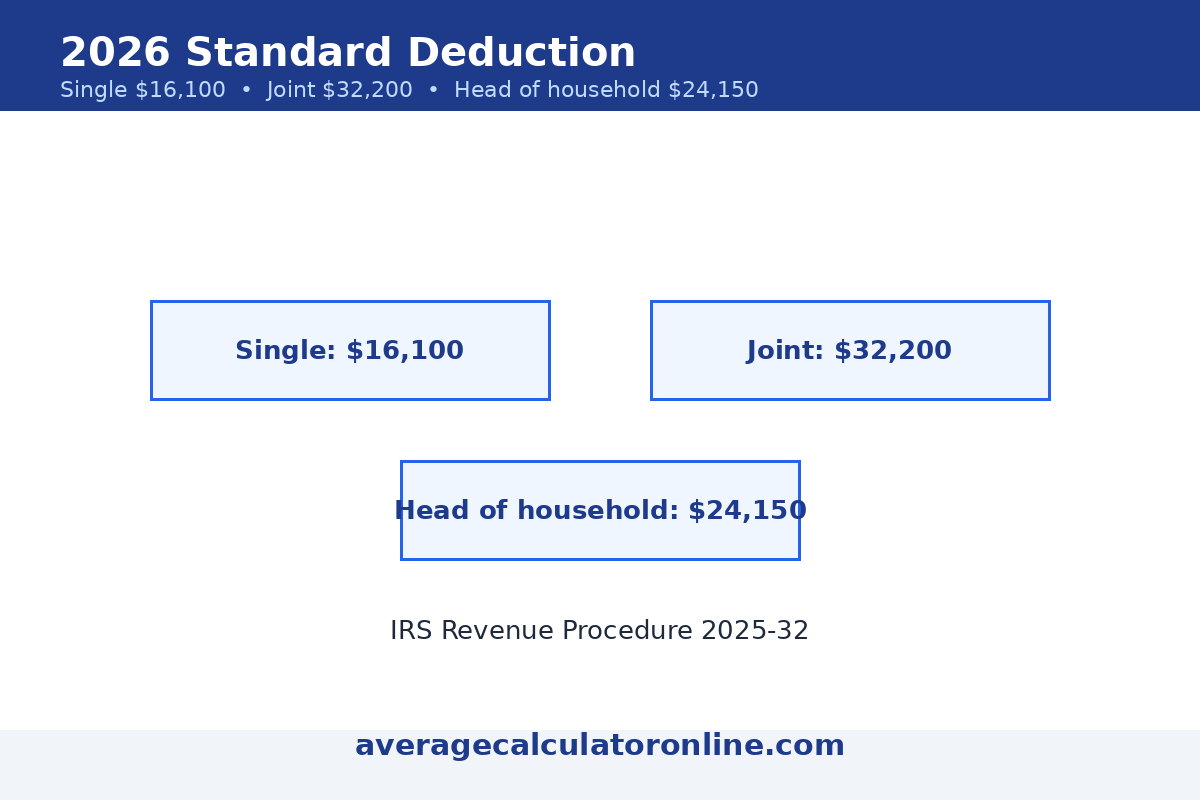
Standard deduction defaults: $16,100 single, $32,200 married filing jointly, $16,100 married filing separately (2026, per IRS Revenue Procedure 2025-32). If you itemize, replace the deduction with your itemized total. Head of household brackets will be added once the IRS figures are verified; the 2026 head-of-household standard deduction is $24,150.
Worked examples
Example 1: Single, $100,000 income, $16,100 deduction → taxable $83,900. Tax = $1,240.00 (10% band) + $4,560.00 (12% band) + $7,370.00 (22% band) = $13,170.00.
Example 2: Married filing jointly, $150,000 income, $32,200 deduction → taxable $117,800. Tax = $2,480.00 (10% band) + $9,120.00 (12% band) + $3,740.00 (22% band) = $15,340.00.
Example 3 — marginal vs effective: The single filer above is “in the 22% bracket,” but only the income above $50,400 is taxed at 22%. The effective rate on the full $100,000 is 13.17% — that is the number that describes the overall burden.
2025 figures for comparison
The calculator previously used 2025 figures. They are kept here for comparison:
| Rate | Single — taxable income up to | Married filing jointly — up to |
|---|---|---|
| 10% | $11,925 | $23,850 |
| 12% | $48,475 | $96,950 |
| 22% | $103,350 | $206,700 |
| 24% | $197,300 | $394,600 |
| 32% | $250,525 | $501,050 |
| 35% | $626,350 | $751,600 |
| 37% | above $626,350 | above $751,600 |
2025 standard deductions: $15,750 single, $31,500 married filing jointly. 2025 example: single, $100,000 income, $15,750 deduction → taxable $84,250. Tax = $1,192.50 (10% band) + $4,386.00 (12% band) + $7,870.50 (22% band) = $13,449.00 (22% marginal, 13.45% effective).
What this estimate leaves out
State income tax, FICA (Social Security and Medicare), tax credits (such as the Child Tax Credit), capital gains rates, the Alternative Minimum Tax, and self-employment tax are not included. This is a federal-income-tax planning estimate only.
Frequently asked questions
How do tax brackets work?
Income is taxed in slices: the first slice at 10%, the next at 12%, and so on. Only the slice inside a bracket gets that bracket’s rate.
What is the difference between marginal and effective rate?
Marginal rate is the rate on your last dollar; effective rate is total tax divided by total income. Effective is almost always lower.
What is the 2026 standard deduction?
$16,100 for single filers and married filing separately, $32,200 for married couples filing jointly, and $24,150 for heads of household, per IRS Revenue Procedure 2025-32. The 2025 figures ($15,750 single / $31,500 joint) are kept in the 2025 comparison table above. Itemize only if your itemized total is higher.
Does this include state tax?
No — federal income tax only. State rates range from 0% to over 13% depending on the state.
Can I use this to file my taxes?
No. Use it for planning; file with IRS-approved software or a tax professional, and verify current figures at irs.gov.
Why is my paycheck withholding different?
Withholding is an estimate spread across paychecks and may not match your final liability, which is why refunds or balances due happen.
Disclaimer: This calculator provides a planning estimate for education only and is not tax, legal, or financial advice. Tax law changes; verify current brackets and deductions at irs.gov and consult a tax professional for your situation.
US Federal Tax: A Deep Dive
The calculator above gives you a fast estimate. This guide explains how that number is actually built — the 2025 federal brackets, the standard deduction, how taxable income is calculated, and a full worked example for a $100,000 single filer — so you understand every dollar of the result.
1. How the 2025 Federal Tax Brackets Work
The United States uses a marginal tax system: your income is taxed in slices (brackets), and only the income inside each slice is taxed at that slice’s rate. Moving into a higher bracket never taxes your whole income at the higher rate — a very common misconception. For 2025, single-filer brackets run from 10% on the first $11,925 of taxable income up to 37% on income above $626,350, and married couples filing jointly get brackets roughly twice as wide.
2. From Gross Income to Taxable Income
You are not taxed on your full salary. Taxable income is what remains after subtractions:
Taxable income = Gross income − Adjustments − Deduction (standard or itemized)
Adjustments — such as pre-tax 401(k) contributions or HSA contributions — come off first. Then you subtract either the standard deduction or your itemized deductions, whichever is larger. Only the result is run through the brackets. And remember, federal income tax is just one slice: FICA (Social Security and Medicare) payroll taxes come off your paycheck separately.
3. The Standard Deduction, Up Close
The standard deduction is a flat amount everyone can subtract — no receipts needed. For 2025 it is $15,750 for single filers and $31,500 for married couples filing jointly. You only itemize if your deductible expenses — state and local taxes (capped at $40,000 for 2025 and $40,400 for 2026 under the One Big Beautiful Bill Act, phasing down above $500,000 of MAGI for 2025 and $505,000 for 2026), mortgage interest, charitable gifts — add up to more than the standard amount. About 9 in 10 filers take the standard deduction because it is larger and far simpler.

4. Worked Example: $100,000 Single Filer
Let’s walk through the exact math the calculator performs, step by step:
- Taxable income: $100,000 − $15,750 standard deduction = $84,250.
- 10% slice: 10% × $11,925 = $1,192.50.
- 12% slice: 12% × ($48,475 − $11,925) = 12% × $36,550 = $4,386.00.
- 22% slice: 22% × ($84,250 − $48,475) = 22% × $35,775 = $7,870.50.
- Total tax: $1,192.50 + $4,386.00 + $7,870.50 = $13,449.00.
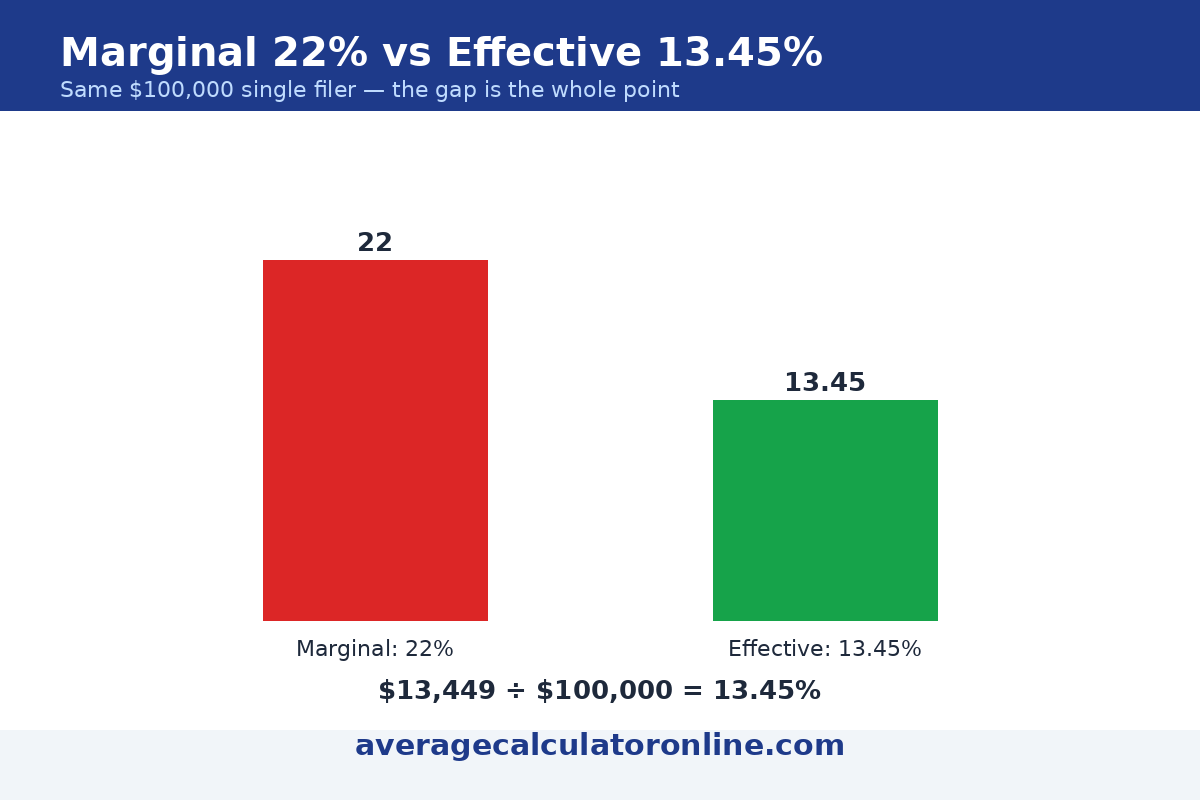
Effective rate = $13,449 ÷ $100,000 = 13.45% — even though the filer’s marginal (top) rate is 22%. That gap is the whole point of the next section.

5. Marginal Rate vs. Effective Rate
Your marginal rate (22% in the example) is the tax on your next dollar of income — the number that matters when you consider overtime, a raise, or extra freelance work. Your effective rate (13.45%) is total tax divided by total income — the share of your pay that actually goes to federal income tax. Under a progressive system, the effective rate is always lower than the marginal rate.
Planning estimates only — not tax advice. Verify current figures with the IRS or a tax professional.
2026 update — what changed
- 2026 standard deduction: $16,100 single, $32,200 married filing jointly, $24,150 head of household, $16,100 married filing separately (IRS Revenue Procedure 2025-32).
- SALT deduction cap: $40,000 for 2025 and $40,400 for 2026 under the One Big Beautiful Bill Act, phasing down above $500,000 of MAGI for 2025 and $505,000 for 2026, with a $10,000 floor.
The calculator above now uses 2026 brackets and 2026 default deductions ($16,100 single / $32,200 joint / $16,100 married filing separately), per IRS Revenue Procedure 2025-32. The 2025 figures are kept in the 2025 comparison section for reference.
Sources & review
Figures on this page were checked against IRS guidance (irs.gov) and IRS Revenue Procedure 2025-32. Reviewed by the Average Calculator Team. Last reviewed: 1 November 2026. This page gives planning estimates only and is not tax advice.
Last updated: November 1, 2026.