
TDEE Calculator
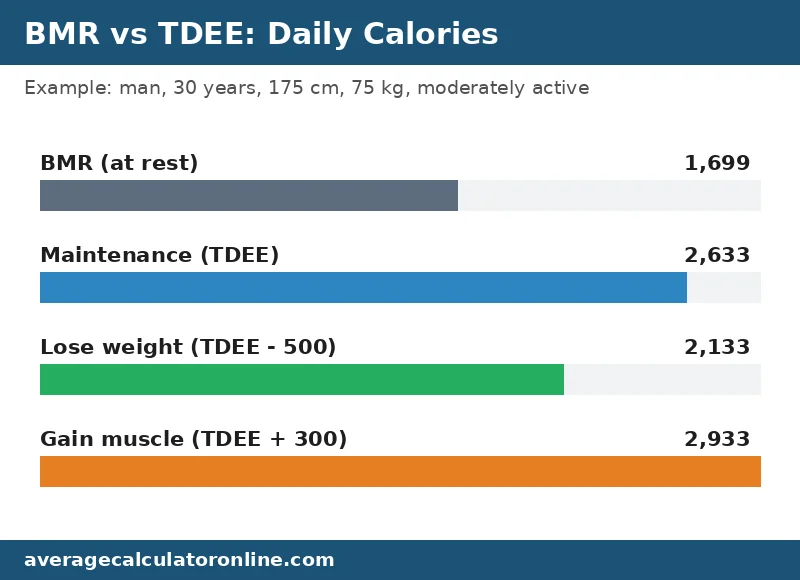
Maintenance: about 2633 calories/day
To lose weight: roughly 2133 calories/day
To gain weight: roughly 3133 calories/day
Direct answer: TDEE = BMR × activity factor. BMR is what you burn at complete rest (Mifflin-St Jeor equation); the activity factor scales it to real life. A moderately active 30-year-old man, 175 cm, 75 kg has a BMR of 1,699 and a TDEE of 2,633 calories/day.
Activity factors
| Level | Factor | Means |
|---|---|---|
| Sedentary | 1.2 | Desk job, little exercise |
| Lightly active | 1.375 | Light exercise 1–3 days/week |
| Moderately active | 1.55 | Moderate exercise 3–5 days/week |
| Very active | 1.725 | Hard exercise 6–7 days/week |
| Extremely active | 1.9 | Physical job plus daily training |
Worked examples
Example 1: Man, 30, 175 cm, 75 kg, moderately active (1.55). BMR = 750 + 1,093.75 − 150 + 5 = 1,699. TDEE = 1,699 × 1.55 = 2,633 calories/day.
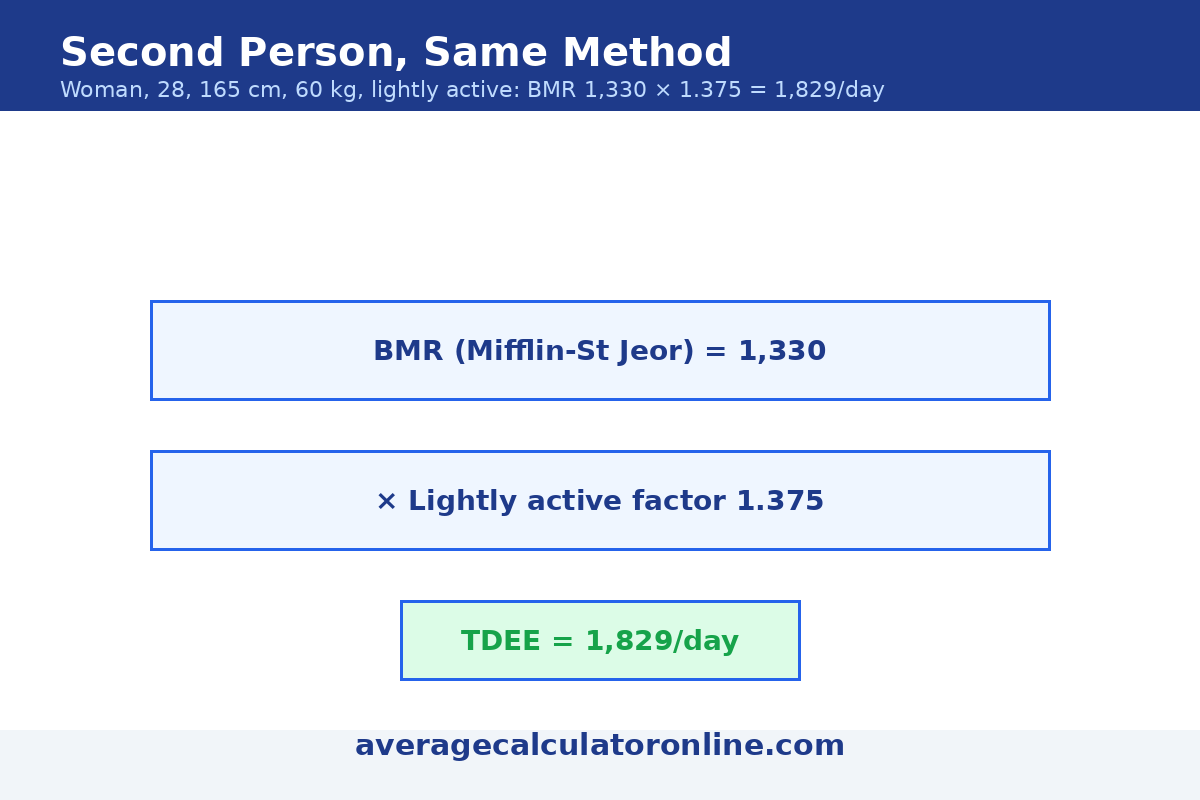
Example 2: Woman, 28, 165 cm, 60 kg, lightly active (1.375). BMR = 600 + 1,031.25 − 140 − 161 = 1,330. TDEE = 1,330 × 1.375 = 1,829 calories/day.
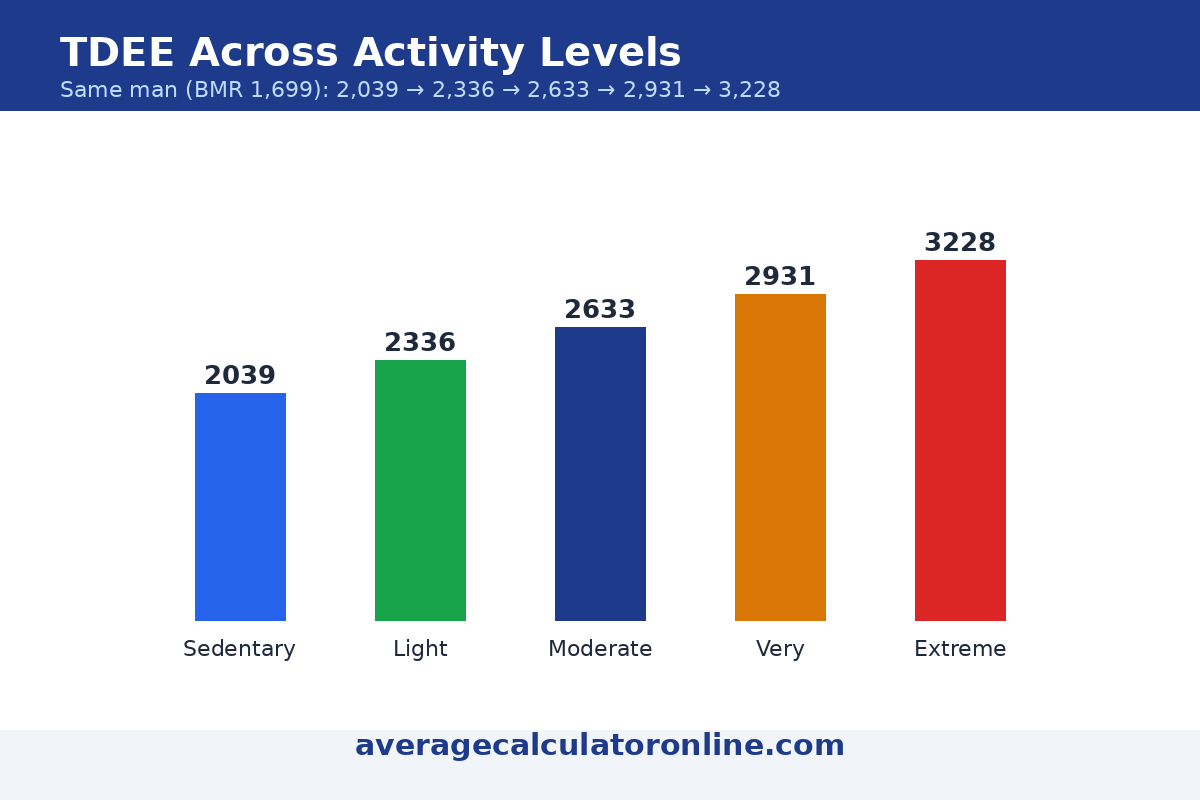
Example 3: Same man as Example 1 but sedentary (1.2): TDEE = 1,699 × 1.2 = 2,039 calories/day — activity level alone changes maintenance by almost 600 calories.
TDEE vs calorie calculator
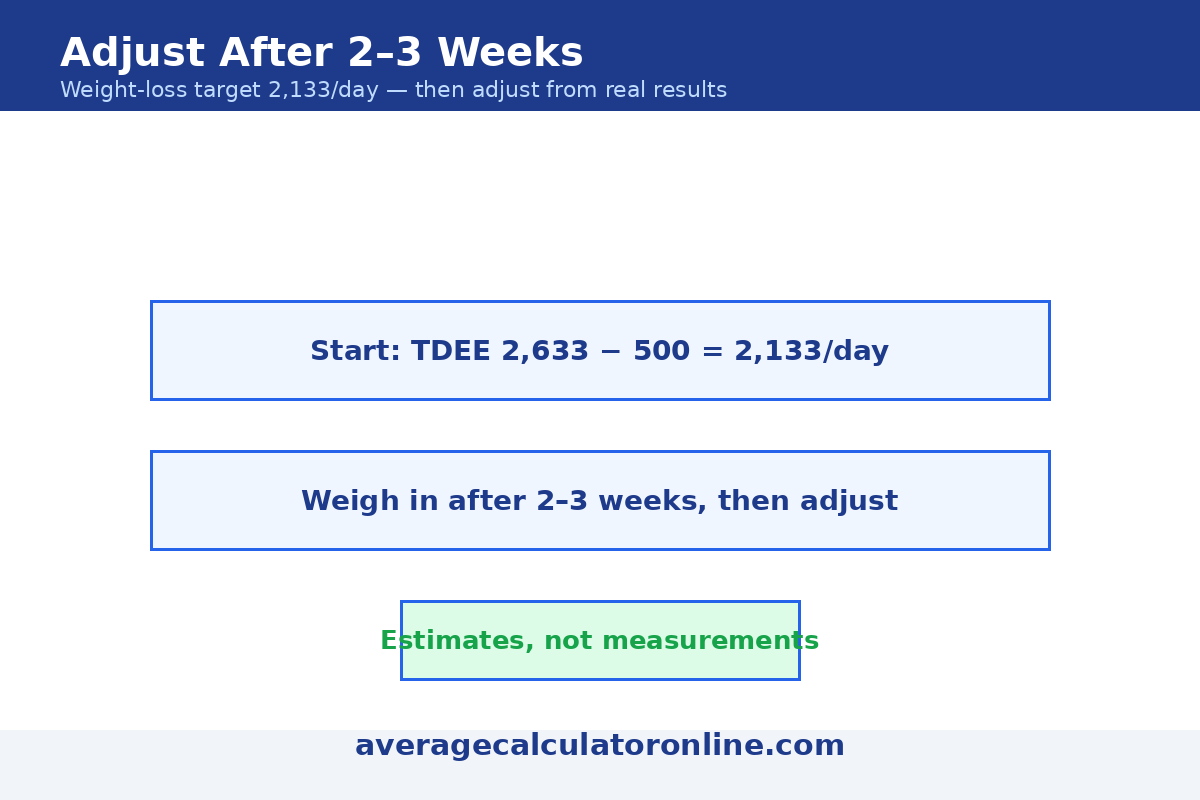
TDEE is your maintenance number: eat at it to hold weight, below it to lose, above it to gain. A 500-calorie daily deficit is the usual starting point for steady loss of about 0.5 kg per week, but adjust after a few weeks based on real results.
Frequently asked questions
What is TDEE?
Total Daily Energy Expenditure — the calories you burn in a day including activity. It equals your BMR multiplied by an activity factor.
What is the difference between BMR and TDEE?
BMR is burn at complete rest; TDEE adds daily movement and exercise, so it is the number you actually need for weight goals.
How many calories should I eat to lose weight?
Start around TDEE minus 500 per day, then adjust from real results after a few weeks.
Which formula is used?
Mifflin-St Jeor: men 10×kg + 6.25×cm − 5×age + 5; women the same minus 161.
Why does activity matter so much?
The factor ranges from 1.2 to 1.9 — the same person can differ by hundreds of calories a day between sedentary and very active.
Is TDEE exact?
No. It is an estimate; body composition, health conditions, and daily variation shift it. Track and adjust.
TDEE: A Deep Dive
The calculator above multiplies your Basal Metabolic Rate (BMR) by an activity factor to estimate how many calories you burn in a full day — your Total Daily Energy Expenditure (TDEE). This guide explains both pieces, how to pick your activity level, and how to turn TDEE into calorie goals.
1. BMR vs. TDEE — What’s the Difference?
BMR is the energy your body burns at complete rest — keeping you breathing, your heart beating, and your brain running — as if you lay in bed all day. TDEE adds everything else on top: walking, working, fidgeting, exercise, and digestion.
This page uses the Mifflin-St Jeor equation, the most widely used BMR formula:
| Gender | BMR formula |
|---|---|
| Men | 10 × weight(kg) + 6.25 × height(cm) − 5 × age + 5 |
| Women | 10 × weight(kg) + 6.25 × height(cm) − 5 × age − 161 |
TDEE then comes from one multiplication: TDEE = BMR × activity factor.
2. Activity Levels and Their Multipliers
Choose the level that matches your typical week — not your best week:
Most people overestimate: be honest, or pick one level lower than you think. Each step up adds roughly 200–250 calories for an average adult.
3. Setting Calorie Goals: Lose, Maintain, or Gain
TDEE is your maintenance number. To aim for a goal, shift from it:
- Lose weight: eat about TDEE − 500 per day → roughly 1 lb (0.45 kg) per week.
- Maintain: eat at TDEE.
- Gain muscle: eat about TDEE + 300 per day, with resistance training.
For the example man with a TDEE of 2,633: weight-loss target ≈ 2,133/day, maintenance = 2,633/day, muscle-gain target ≈ 2,933/day.
4. Splitting Calories into Macros
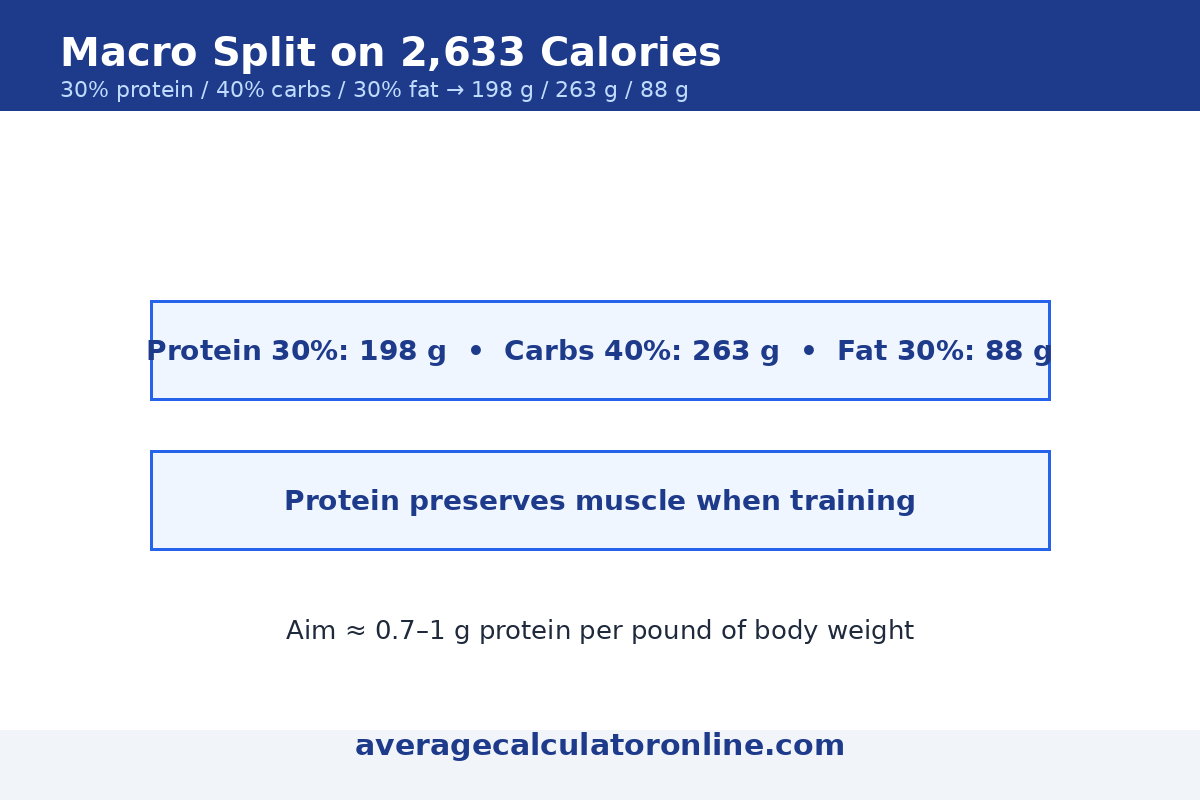
Calories tell you how much to eat; macros tell you what to eat it as. A balanced starting split for an active adult is 30% protein / 40% carbs / 30% fat. Protein preserves muscle (aim for about 0.7–1 g per pound of body weight when training), carbs fuel workouts, and fat supports hormones.
Estimates only — not medical or nutrition advice. TDEE is an approximation; body composition, health conditions, and daily variation all affect your true burn. Consult a professional for personalized guidance.
Last updated: November 1, 2026.