
Due Date Calculator
Direct answer
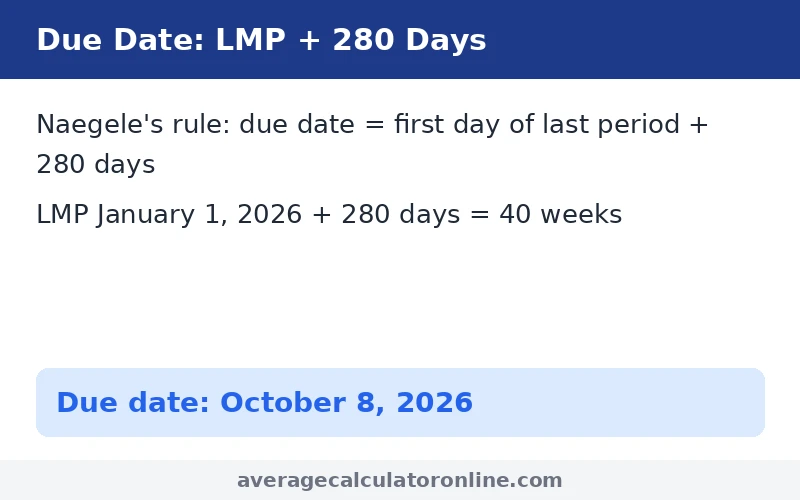
Your estimated due date is the first day of your last menstrual period (LMP) plus 280 days — Naegele’s rule, or 40 weeks:
Due date = LMP + 280 days
With an LMP of January 1, 2026, the due date is October 8, 2026. Enter your own LMP below and the tool works out the same date for you, plus the conception estimate, your current week and day, and the dates your second and third trimesters start.
Estimates only, not a substitute for medical advice. Due dates are estimates: your healthcare provider may adjust the date after an ultrasound, and only they can confirm how far along you are.
Due Date Calculator
Inputs
| Field | Default | Notes |
|---|---|---|
| First day of last menstrual period (LMP) | 140 days before today | Date input |
| Average cycle length | 28 days | Optional; used only for the conception estimate (range clamped to 21–45) |
Outputs
| Output | Formula | Default result |
|---|---|---|
| Estimated due date | LMP + 280 days | 140 days from now |
| Estimated conception date | LMP + (cycle − 14) days | 126 days ago |
| Current week/day of pregnancy | Days since LMP ÷ 7 | Computed live against today’s date |
| Second trimester starts | LMP + 91 days (week 14) | 49 days ago |
| Third trimester starts | LMP + 189 days (week 28) | 49 days from now |
Defaults on load: LMP 140 days ago, cycle 28 days → due date 140 days from now. The result shows as soon as the page loads, before you enter anything.
How it works
- Start from the LMP. Pregnancy is counted from the first day of your last menstrual period, not from conception — that is why the standard length is 40 weeks (280 days) rather than 38.
- Add 280 days. That is Naegele’s rule: LMP + 280 days = the estimated due date. January 1, 2026 + 280 days = October 8, 2026.
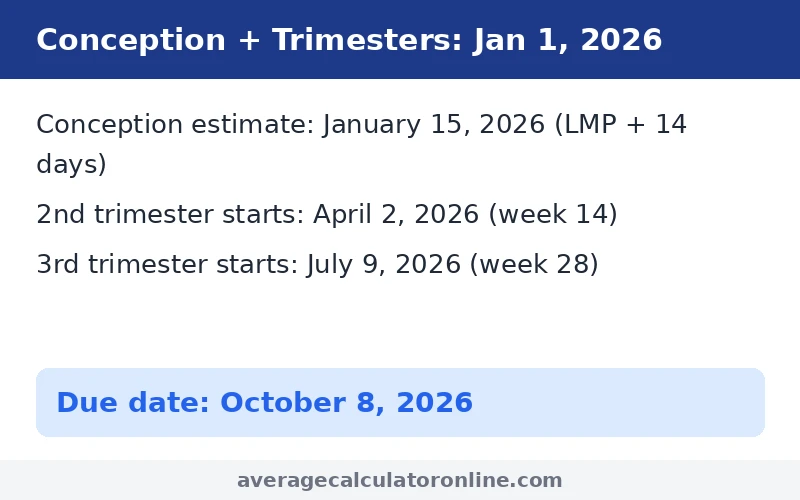
- Estimate conception. Ovulation usually happens about 14 days before the next period, so conception is estimated at LMP + (cycle length − 14) days. For a 28-day cycle that is LMP + 14 days: January 15, 2026.
- Count the weeks. Days since the LMP divided by 7 gives the current week and day — for example, 90 days after the LMP is 12 weeks, 6 days.
- Mark the trimesters. The second trimester starts at week 14 (LMP + 91 days) and the third at week 28 (LMP + 189 days).
Weeks to months (approximate)
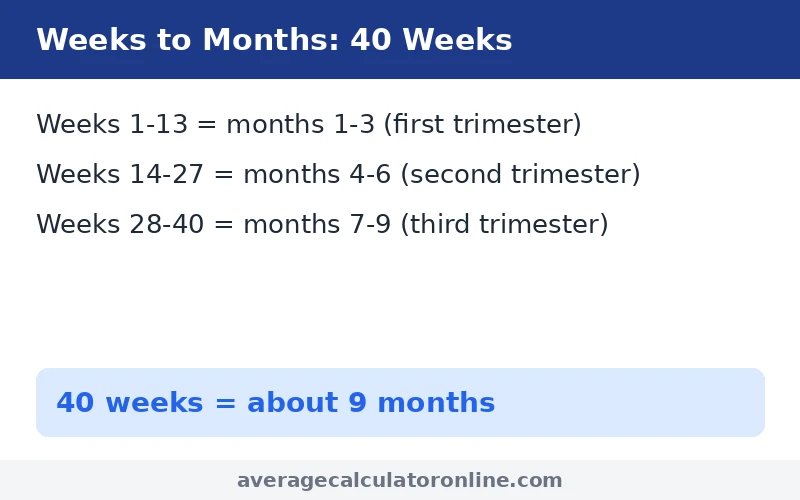
Pregnancy months do not line up exactly with calendar months, so this table is the usual approximation:
| Weeks | Approximate month | Trimester |
|---|---|---|
| 1–4 | Month 1 | First |
| 5–8 | Month 2 | First |
| 9–13 | Month 3 | First |
| 14–17 | Month 4 | Second |
| 18–21 | Month 5 | Second |
| 22–26 | Month 6 | Second |
| 27–30 | Month 7 | Third |
| 31–35 | Month 8 | Third |
| 36–40 | Month 9 | Third |
Trimester dates for the default LMP (January 1, 2026)
| Trimester | Weeks | Dates |
|---|---|---|
| First | 1–13 | January 1 – April 1, 2026 |
| Second | 14–27 | April 2 – July 8, 2026 |
| Third | 28–40 | July 9 – October 8, 2026 |
Second trimester starts at LMP + 91 days (April 2, 2026); third trimester starts at LMP + 189 days (July 9, 2026); the 40th week ends at LMP + 279 days (October 7, 2026), with the due date on day 280 (October 8, 2026). Ovulation sits about two weeks after the last period, so the ovulation calculator can estimate the fertile window behind this due date, and the pregnancy calculator shows the same due date with the trimester dates and current week.
Worked examples
Example 1 — The default: LMP January 1, 2026, 28-day cycle
- Due date: January 1, 2026 + 280 days = October 8, 2026 (Thursday)
- Conception estimate: January 1, 2026 + 14 days = January 15, 2026 (Thursday)
- Second trimester starts: January 1, 2026 + 91 days = April 2, 2026
- Third trimester starts: January 1, 2026 + 189 days = July 9, 2026
- As of November 5, 2026: 308 days since LMP = 44 weeks, 0 days — 28 days past the estimated due date.
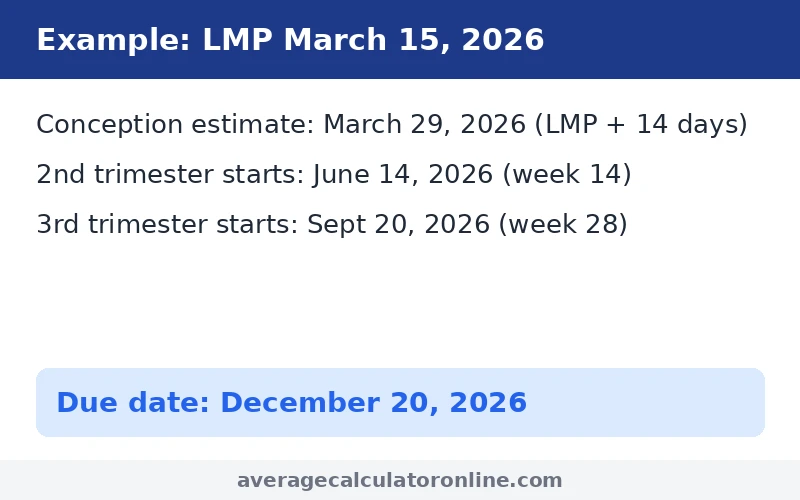
Example 2 — LMP March 15, 2026, 28-day cycle
- Due date: March 15, 2026 + 280 days = December 20, 2026 (Sunday)
- Conception estimate: March 15, 2026 + 14 days = March 29, 2026 (Sunday)
- Second trimester starts: March 15, 2026 + 91 days = June 14, 2026
- Third trimester starts: March 15, 2026 + 189 days = September 20, 2026
- As of June 1, 2026: 78 days since LMP = 11 weeks, 1 day; 202 days remaining to the due date.
Example 3 — A longer cycle: LMP May 10, 2026, 32-day cycle
- Due date: May 10, 2026 + 280 days = February 14, 2027 (Sunday) — Naegele’s rule still counts from the LMP, so the cycle length does not move the due date.
- Conception estimate: May 10, 2026 + (32 − 14) = +18 days = May 28, 2026 (Thursday) — later than the 14-day default.
- Second trimester starts: May 10, 2026 + 91 days = August 9, 2026
- Third trimester starts: May 10, 2026 + 189 days = November 15, 2026
- As of August 1, 2026: 83 days since LMP = 11 weeks, 6 days; 197 days remaining to the due date.
- Note the check: May 28, 2026 + 266 days = February 18, 2027, four days after the Naegele date — the conception-based formula assumes ovulation on day 14, so with a 32-day cycle the two methods differ. The tool uses the LMP-based date as the due date.
Example 4 — How the week and day are counted: LMP January 1, 2026, on April 1, 2026
- Days elapsed: April 1, 2026 − January 1, 2026 = 90 days
- 90 ÷ 7 = 12 full weeks with 6 days left over → 12 weeks, 6 days pregnant
- Days remaining to the due date: 280 − 90 = 190 days
- The second trimester starts the next day, April 2, 2026 (week 14).
Tips and mistakes
- Use the first day of your last period. Not the last day of the period, and not the day you got a positive test — the count starts on day one of the LMP.
- Do not count 40 weeks from conception. Conception to due date is 38 weeks (266 days); the 40 weeks (280 days) are counted from the LMP. Mixing the two up moves the date by two weeks.
- A longer or shorter cycle moves the conception estimate, not the due date. Naegele’s rule counts from the LMP either way; the cycle length only shifts the estimated conception day (LMP + cycle − 14).
- Ultrasound dating can move the date. If an early ultrasound gives a different date, your healthcare provider’s date takes priority over this calculator.
- A due date is an estimate, not an appointment. Most births happen in the weeks around the due date, so treat the date as the middle of a window, not a deadline.
- Do not use this tool for medical decisions. It is an estimate from the dates you enter — see the disclaimer below.
Sources
Due-date maths follows Naegele’s rule (LMP + 280 days), described by the American College of Obstetricians and Gynecologists (ACOG) in Committee Opinion No. 700, Methods for Estimating the Due Date. For general pregnancy information, see MedlinePlus — Pregnancy. Reviewed by the Average Calculator Team. Last reviewed: 7 November 2026.
FAQs
How do you calculate a due date?
Add 280 days (40 weeks) to the first day of your last menstrual period — Naegele’s rule. For example, an LMP of January 1, 2026 gives a due date of October 8, 2026.
How accurate is a due date calculator?
It is an estimate. The date is calculated from the LMP and an assumed 28-day cycle, and your healthcare provider may adjust it after an ultrasound. Most births happen in the weeks around the due date rather than on the date itself.
What is Naegele’s rule?
Naegele’s rule is the standard due-date formula: due date = first day of the last menstrual period + 280 days (40 weeks). It assumes a regular 28-day cycle with ovulation around day 14.
How do I calculate my due date from the conception date?
Add 266 days (38 weeks) to the conception date. For example, a conception date of January 15, 2026 + 266 days = October 8, 2026, the same date Naegele’s rule gives for an LMP of January 1, 2026. This assumes ovulation around day 14; with a longer cycle the two methods can differ by a few days.
How many weeks pregnant am I?
Count the days from the first day of your last period and divide by 7. For example, 90 days after an LMP of January 1, 2026 (on April 1, 2026) is 12 weeks, 6 days pregnant. Enter your LMP above and the tool works this out against today’s date.
When do the trimesters start?
The second trimester starts at week 14 (LMP + 91 days) and the third trimester starts at week 28 (LMP + 189 days). For an LMP of January 1, 2026, that is April 2, 2026 and July 9, 2026.
Disclaimer
Estimates only, not a substitute for medical advice. This calculator gives an estimated due date from the dates you enter, using Naegele’s rule (LMP + 280 days). It does not diagnose, predict, or replace professional medical care. Your healthcare provider may give a different date after an examination or ultrasound, and their date takes priority. If you have any concerns about your pregnancy, contact your healthcare provider. This page is educational only.
Related calculators
- Average Calculator Online — the homepage average tool
- Pregnancy Calculator — pregnancy weeks and milestones, for readers who want more than the due date
- Age Calculator — age in years, months and days between two dates
- Time Calculator — add or subtract days, hours and minutes between dates
- Calorie Calculator — daily calorie needs, including during pregnancy planning
Last updated: November 7, 2026.