
Ovulation Calculator
Direct answer
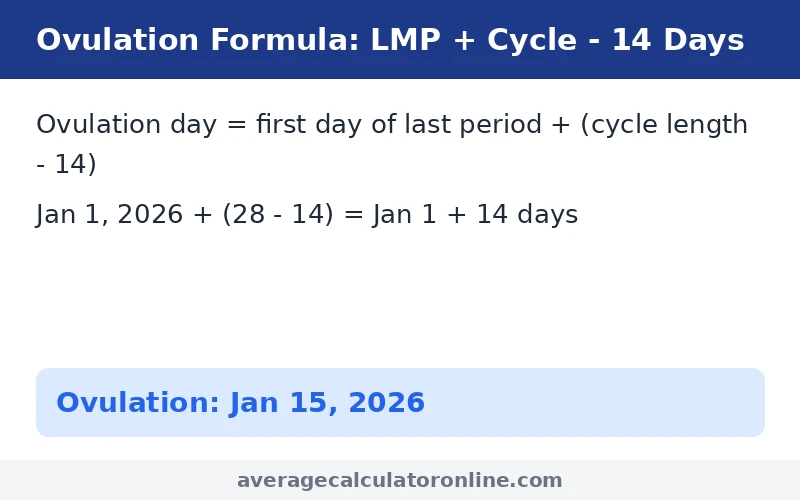
Your estimated ovulation day is the first day of your last menstrual period (LMP) plus your cycle length minus 14 days:
Ovulation ≈ LMP + (Cycle length − 14 days)
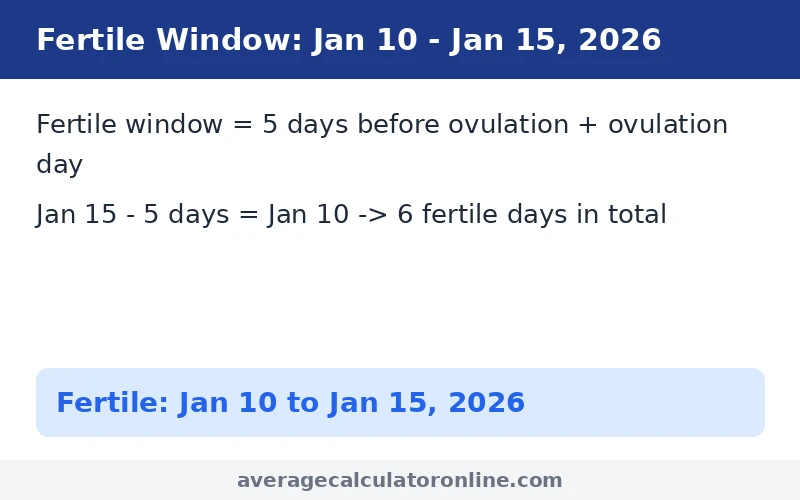
Your fertile window is the 5 days before ovulation plus ovulation day itself — 6 days in total. For example, with LMP January 1, 2026 and a 28-day cycle, ovulation is estimated on January 15, 2026, the fertile window is January 10–15, 2026, and the next period is expected on January 29, 2026.
Estimates only, not a substitute for medical advice. These dates are estimates based on average cycle timing. Ovulation varies from cycle to cycle, and this calculator cannot confirm whether or when you ovulated. Talk to a doctor or other qualified health professional about fertility, pregnancy, or any health concern.
The tool
Ovulation Calculator
Inputs
| Field | Default | Unit |
|---|---|---|
| First day of last menstrual period | 14 days before today | date |
| Average cycle length | 28 | days |
Outputs
| Output | Formula | Default result |
|---|---|---|
| Estimated ovulation date | LMP + (cycle − 14) days | Today |
| Fertile window start | Ovulation − 5 days | 5 days before today |
| Fertile window end | Ovulation day | Today |
| Next period expected | LMP + cycle days | 14 days from now |
Defaults on load: LMP 14 days ago, cycle 28 days → ovulation today, fertile window the five days before today through today, next period in 14 days. The tool must show these results before the visitor types anything, and must recalculate on every input change.
How it works
- Enter the first day of your last period. This is day 1 of the cycle — the first day of menstrual bleeding, not the last day.
- Enter your average cycle length. A cycle is counted from the first day of one period to the first day of the next. The average of your last few cycles is more useful than a single cycle.
- Subtract 14 days. Ovulation usually happens about 14 days before the next period, so the estimate is LMP + (cycle length − 14). For a 28-day cycle that is day 14; for a 30-day cycle it is day 16; for a 24-day cycle it is day 10.
- Read the fertile window. The 5 days before ovulation plus ovulation day itself are the days when conception is most likely, because sperm can survive in the body for several days before the egg is released.
- Read the next period date. Adding the full cycle length to the LMP gives the expected first day of the next period.
Ovulation day by cycle length (recomputed)
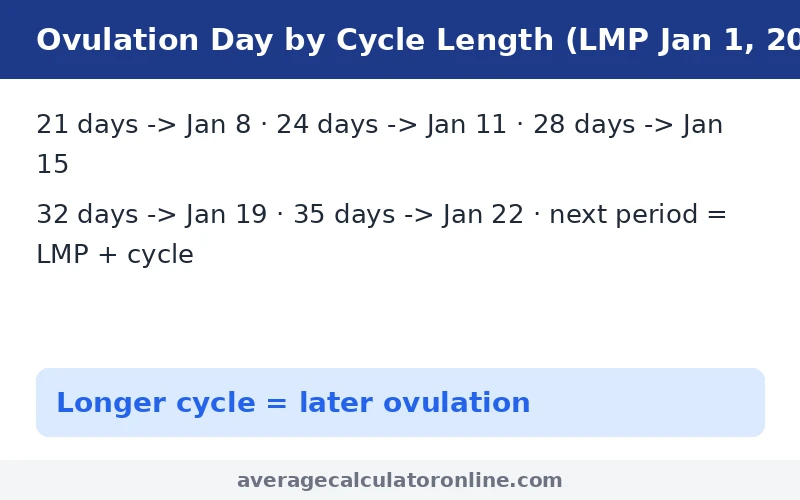
All rows use the same LMP: January 1, 2026. Ovulation = LMP + (cycle − 14); fertile window = ovulation − 5 days to ovulation day; next period = LMP + cycle length.
| Cycle length | Ovulation day | Fertile window | Next period |
|---|---|---|---|
| 21 days | January 8, 2026 | January 3–8, 2026 | January 22, 2026 |
| 22 days | January 9, 2026 | January 4–9, 2026 | January 23, 2026 |
| 23 days | January 10, 2026 | January 5–10, 2026 | January 24, 2026 |
| 24 days | January 11, 2026 | January 6–11, 2026 | January 25, 2026 |
| 25 days | January 12, 2026 | January 7–12, 2026 | January 26, 2026 |
| 26 days | January 13, 2026 | January 8–13, 2026 | January 27, 2026 |
| 27 days | January 14, 2026 | January 9–14, 2026 | January 28, 2026 |
| 28 days | January 15, 2026 | January 10–15, 2026 | January 29, 2026 |
| 29 days | January 16, 2026 | January 11–16, 2026 | January 30, 2026 |
| 30 days | January 17, 2026 | January 12–17, 2026 | January 31, 2026 |
| 31 days | January 18, 2026 | January 13–18, 2026 | February 1, 2026 |
| 32 days | January 19, 2026 | January 14–19, 2026 | February 2, 2026 |
| 33 days | January 20, 2026 | January 15–20, 2026 | February 3, 2026 |
| 34 days | January 21, 2026 | January 16–21, 2026 | February 4, 2026 |
| 35 days | January 22, 2026 | January 17–22, 2026 | February 5, 2026 |
A longer cycle moves ovulation later; a shorter cycle moves it earlier. The fertile window is always 6 days long in this estimate. If ovulation leads to a pregnancy, the due date calculator can estimate the due date from your last period, and the pregnancy calculator shows the trimester dates and current week.
Worked examples (all recomputed)
Example 1 — A 28-day cycle, LMP January 1, 2026
- Ovulation: January 1 + (28 − 14) = January 1 + 14 days = January 15, 2026
- Fertile window: January 15 − 5 days = January 10, 2026 to January 15, 2026
- Next period: January 1 + 28 days = January 29, 2026
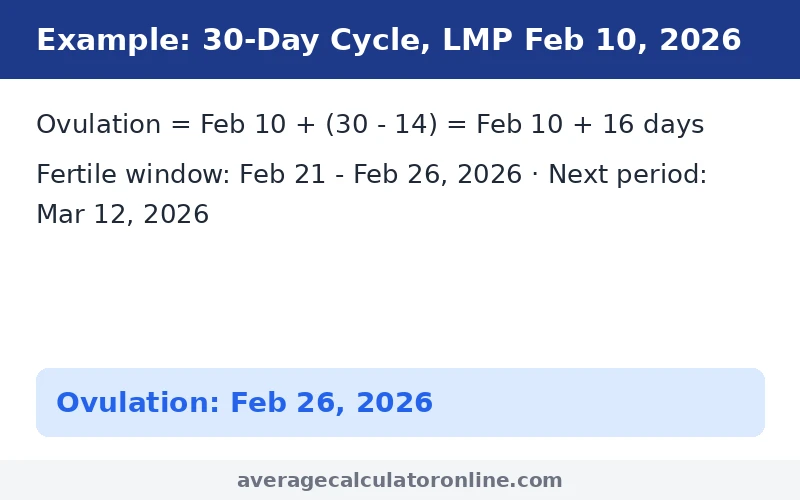
Example 2 — A 30-day cycle: LMP February 10, 2026
- Ovulation: February 10 + (30 − 14) = February 10 + 16 days = February 26, 2026
- Fertile window: February 26 − 5 days = February 21, 2026 to February 26, 2026
- Next period: February 10 + 30 days = March 12, 2026
Example 3 — A 24-day cycle: LMP March 5, 2026
- Ovulation: March 5 + (24 − 14) = March 5 + 10 days = March 15, 2026
- Fertile window: March 15 − 5 days = March 10, 2026 to March 15, 2026
- Next period: March 5 + 24 days = March 29, 2026
Example 4 — A 35-day cycle: LMP April 18, 2026
- Ovulation: April 18 + (35 − 14) = April 18 + 21 days = May 9, 2026
- Fertile window: May 9 − 5 days = May 4, 2026 to May 9, 2026
- Next period: April 18 + 35 days = May 23, 2026
Tips and mistakes
- Use the first day of bleeding as day 1. Counting from the last day of a period, or from spotting, shifts every date on the page by several days.
- Average several cycles. One unusual cycle (stress, illness, travel) is not your average. Add up your last 3–6 cycle lengths and divide by the number of cycles.
- Do not rely on the 14-day rule alone if your cycles are irregular. The estimate assumes the second half of the cycle (after ovulation) is about 14 days. With irregular cycles the actual ovulation day can be several days earlier or later than the estimate.
- The fertile window is wider than ovulation day. Conception is possible on any of the 6 days, not only on ovulation day itself, because sperm can survive for several days before the egg is released.
- Do not use this calculator to avoid pregnancy. Calendar estimates are not reliable contraception. If you need to avoid pregnancy, talk to a doctor or other qualified health professional about methods that suit you.
- Track more than dates. Cervical mucus, basal body temperature and ovulation test strips give additional signs, but none of them confirm ovulation on their own either.
Sources
Ovulation timing (ovulation about 14 days before the next period) follows the standard cycle model described by the American College of Obstetricians and Gynecologists (ACOG). For general pregnancy information, see MedlinePlus — Pregnancy. Reviewed by the Average Calculator Team. Last reviewed: 7 November 2026.
FAQs
How do you calculate an ovulation date?
Take the first day of your last menstrual period and add your cycle length minus 14 days: Ovulation ≈ LMP + (cycle length − 14). For example, with an LMP of January 1, 2026 and a 28-day cycle, ovulation is estimated on January 1 + 14 days = January 15, 2026.
What is the fertile window?
The fertile window is the 5 days before ovulation plus ovulation day itself — 6 days in total. For the default example (ovulation January 15, 2026) the fertile window is January 10–15, 2026. These are the days when conception is most likely.
How accurate is an ovulation calculator?
It is an estimate, not a measurement. It assumes the second half of the cycle is about 14 days and that your cycle length is stable. Real ovulation can fall several days earlier or later, especially with irregular cycles, stress, illness or recent hormonal changes. Only a clinician’s tests can confirm ovulation.
Can I ovulate on a different day than the estimate?
Yes. The estimate uses an average cycle length, so any cycle that is longer or shorter than your average moves ovulation. Even with regular cycles, the exact day varies from cycle to cycle.
What if my cycle length varies from month to month?
Use the average of your last 3–6 cycles as the input, and treat the result as a range rather than a single day. If your cycles are very irregular (for example, varying by more than 7 days), a calendar estimate is less useful and a doctor can advise on better ways to track ovulation.
Can I use this calculator to avoid pregnancy?
No. Calendar-based estimates are not reliable contraception, because ovulation can shift and sperm can survive for several days. If you want to avoid pregnancy, talk to a doctor or other qualified health professional about contraception methods.
Disclaimer
Estimates only, not a substitute for medical advice. The dates on this page are estimates calculated from the numbers you enter, using the standard calendar method (ovulation about 14 days before the next period). They do not diagnose, treat, or confirm ovulation, fertility, or pregnancy, and they are not reliable contraception. Always talk to a doctor or other qualified health professional about fertility, pregnancy, or any health concern.
Related calculators
- Average Calculator Online — the homepage average tool
- Age Calculator — age from a date of birth
- BMI Calculator — body mass index from height and weight
- Calorie Calculator — daily calorie needs
- Pregnancy Calculator — pregnancy weeks and milestones
Last updated: November 7, 2026.