Dice Average Calculator
Direct answer
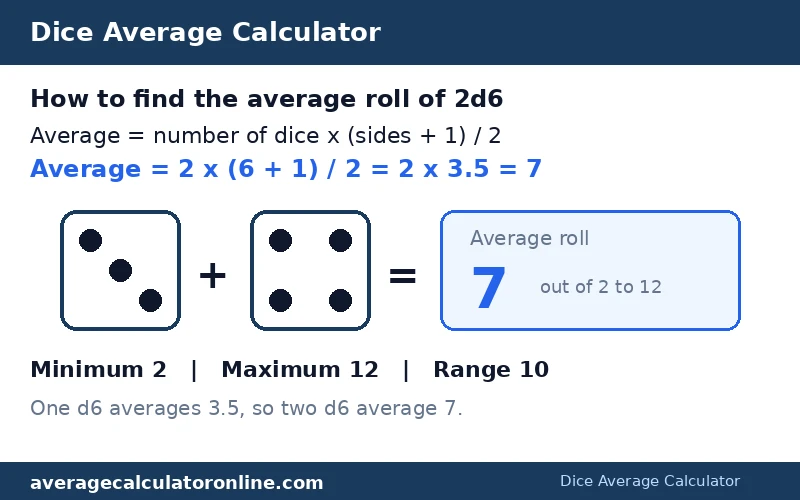
The average roll of 2d6 is 7. A single d6 averages 3.5, because its faces 1 to 6 add to 21 and 21 ÷ 6 = 3.5, so two d6 average 2 × 3.5 = 7. The lowest possible total is 2, the highest is 12, and the range is 10.
Average = number of dice × (sides + 1) ÷ 2 + modifier · Minimum = number of dice × 1 + modifier · Maximum = number of dice × sides + modifier
For the default roll 2d6 with no modifier: average 7, minimum 2, maximum 12, range 10, and the most likely total is 7 (6 of 36 outcomes, 16.67%). Enter your own dice below and the tool computes the average, minimum, maximum, range and the full probability table for you.
Dice Average Calculator
Presets:
Inputs
| Field | Default |
|---|---|
| Dice type (select) | d6 (6 sides) |
| Number of dice (1–10) | 2 |
| Modifier (−10 to +10) | 0 |
| Preset buttons | 1d20, 2d6, 3d6, 1d20+5, 2d20 |
Outputs
| Output | Formula | Default result |
|---|---|---|
| Average roll | n × (sides + 1) ÷ 2 + modifier | 7 |
| Minimum | n × 1 + modifier | 2 |
| Maximum | n × sides + modifier | 12 |
| Range | Maximum − Minimum | 10 |
| Total possible outcomes | sides ^ n | 36 |
| Most likely total | Highest outcome count | 7 (6 of 36, 16.67%) |
| Probability table | Exact count ÷ total outcomes | Totals 2–12 (see table below) |
Defaults on load: 2d6, modifier 0 → average 7, minimum 2, maximum 12, range 10, most likely total 7. The tool must show these results before the visitor types anything, and must recalculate on every input change. Number of dice is clamped to 1–10 and the modifier to −10 to +10; no result is ever NaN or Infinity.
How it works
- Average of one die. Add the faces and divide by how many there are. For a d6 the faces are 1, 2, 3, 4, 5, 6, which add to 21, so the average is 21 ÷ 6 = 3.5. In general, one die with S sides averages (S + 1) ÷ 2 — the midpoint of 1 and S. That is why a d20 averages 10.5, a d4 averages 2.5, and a d100 averages 50.5.
- Average of several dice. Multiply the one-die average by the number of dice. Two d6 average 2 × 3.5 = 7; three d6 average 3 × 3.5 = 10.5; two d20 average 2 × 10.5 = 21. This works because the average of a sum is the sum of the averages, whatever the dice are.
- Modifier last. Add the modifier once, after averaging — never once per die. 1d20+5 averages 10.5 + 5 = 15.5, not 10.5 + 5 × 1 in any other way, and 2d6+3 averages 7 + 3 = 10. The modifier also shifts the minimum and maximum by the same amount, but it does not change the range.
- Minimum, maximum and range. The minimum is all dice showing 1, plus the modifier: n × 1 + modifier. The maximum is all dice showing their highest face, plus the modifier: n × sides + modifier. The range is maximum minus minimum, which is n × (sides − 1) — for 2d6 that is 12 − 2 = 10.
- Probability table. The tool counts every possible combination exactly. For 2d6 there are 6 × 6 = 36 outcomes; total 7 comes from six of them (1+6, 2+5, 3+4, 4+3, 5+2, 6+1), so P(7) = 6 ÷ 36 = 16.67%. For 3 or more dice the tool shows the full table whenever the total outcomes are 10,000 or fewer (for example 3d6 has 216 outcomes and 3d20 has 8,000); above 10,000 outcomes it shows the minimum, maximum, average and the most likely total instead, because a table of a million rows helps nobody.
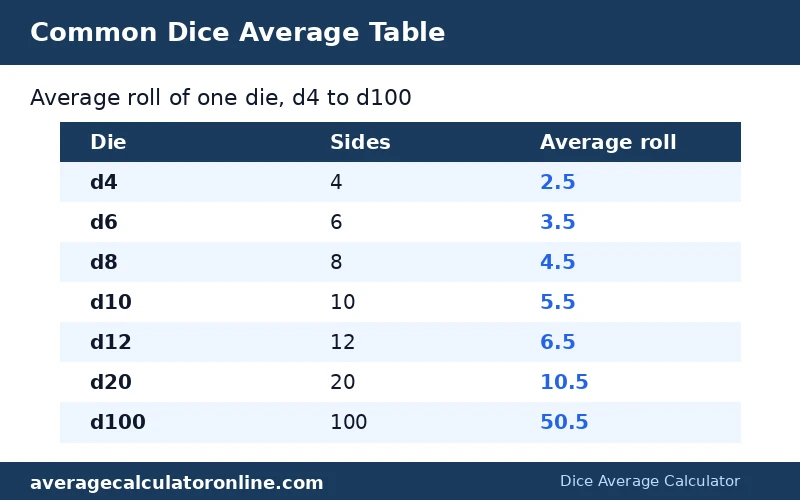
Common dice averages (one die, no modifier)
| Die | Sides | Faces | Average roll |
|---|---|---|---|
| d4 | 4 | 1–4 | 2.5 |
| d6 | 6 | 1–6 | 3.5 |
| d8 | 8 | 1–8 | 4.5 |
| d10 | 10 | 1–10 | 5.5 |
| d12 | 12 | 1–12 | 6.5 |
| d20 | 20 | 1–20 | 10.5 |
| d100 | 100 | 1–100 | 50.5 |
Every average is (sides + 1) ÷ 2. A d100 is usually rolled as two d10 (tens and ones), but its average is still 50.5.
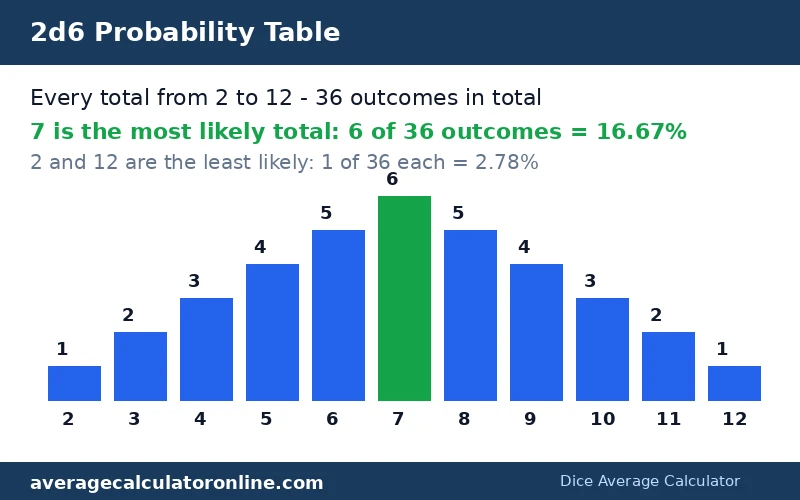
2d6 distribution (36 outcomes)
| Total | Ways to roll it | Probability |
|---|---|---|
| 2 | 1 | 2.78% |
| 3 | 2 | 5.56% |
| 4 | 3 | 8.33% |
| 5 | 4 | 11.11% |
| 6 | 5 | 13.89% |
| 7 | 6 | 16.67% |
| 8 | 5 | 13.89% |
| 9 | 4 | 11.11% |
| 10 | 3 | 8.33% |
| 11 | 2 | 5.56% |
| 12 | 1 | 2.78% |
The distribution is symmetric around 7: totals 2 and 12 are equally rare (1 of 36 each), and 7 is the single most likely total.
3d6 key probabilities (216 outcomes)
| Total | Ways to roll it | Probability |
|---|---|---|
| 3 | 1 | 0.46% |
| 10 | 27 | 12.50% |
| 11 | 27 | 12.50% |
| 18 | 1 | 0.46% |
With three dice the average 10.5 sits between the two most likely totals, 10 and 11, which are equally likely at 27 of 216 each. The extremes 3 and 18 each have only one way to appear.
Preset combinations at a glance
| Roll | Average | Minimum | Maximum | Range |
|---|---|---|---|---|
| 1d20 | 10.5 | 1 | 20 | 19 |
| 2d6 | 7 | 2 | 12 | 10 |
| 3d6 | 10.5 | 3 | 18 | 15 |
| 1d20+5 | 15.5 | 6 | 25 | 19 |
| 2d20 | 21 | 2 | 40 | 38 |
Worked examples (all recomputed in node)
Example 1 — The default roll: 2d6 averages 7
- One d6 averages (6 + 1) ÷ 2 = 3.5
- Two d6 average 2 × 3.5 = 7
- Minimum: 1 + 1 = 2; maximum: 6 + 6 = 12; range: 12 − 2 = 10
- Most likely total is 7: six ways (1+6, 2+5, 3+4, 4+3, 5+2, 6+1) out of 36, so P(7) = 6 ÷ 36 = 16.67%
- Least likely totals are 2 and 12: one way each, 1 ÷ 36 = 2.78%
Example 2 — 1d20+5 averages 15.5
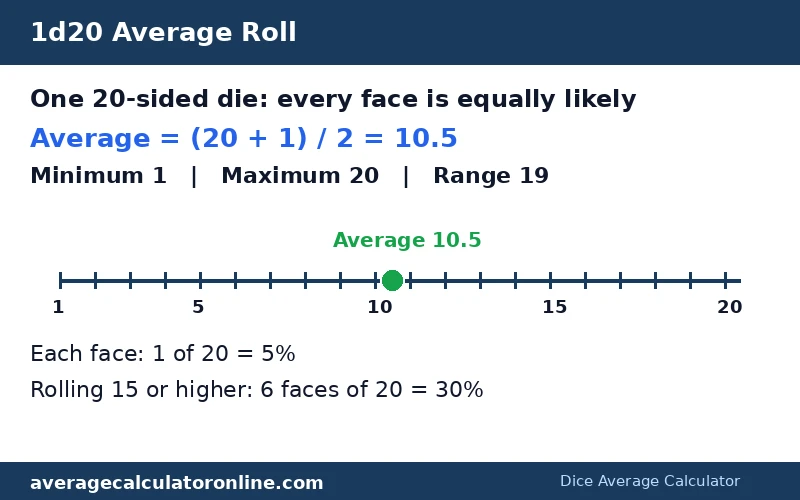
- One d20 averages (20 + 1) ÷ 2 = 10.5
- Add the modifier once: 10.5 + 5 = 15.5
- Minimum: 1 + 5 = 6; maximum: 20 + 5 = 25; range: 25 − 6 = 19 (unchanged by the modifier)
- On a plain 1d20, every face has the same chance: 1 of 20 = 5%
- Rolling 15 or higher on a plain 1d20 means faces 15, 16, 17, 18, 19, 20 — six faces — so P(15 or higher) = 6 ÷ 20 = 30%
Example 3 — 3d6 averages 10.5
- Three d6 average 3 × 3.5 = 10.5
- Minimum: 1 + 1 + 1 = 3; maximum: 6 + 6 + 6 = 18; range: 18 − 3 = 15
- Total outcomes: 6 × 6 × 6 = 216
- Most likely totals are 10 and 11: 27 ways each, so P(10) = P(11) = 27 ÷ 216 = 12.50%
- Least likely totals are 3 and 18: one way each, 1 ÷ 216 = 0.46%
Example 4 — 2d12+3 averages 16
- One d12 averages (12 + 1) ÷ 2 = 6.5
- Two d12 average 2 × 6.5 = 13; add the modifier once: 13 + 3 = 16
- Minimum: 1 + 1 + 3 = 5; maximum: 12 + 12 + 3 = 27; range: 27 − 5 = 22
- Total outcomes: 12 × 12 = 144
- For comparison, 4d6 averages 4 × 3.5 = 14 (minimum 4, maximum 24, range 20), and 1d100 averages 50.5 (minimum 1, maximum 100, range 99)
Tips and mistakes
- The average is not always a rollable total. A single d20 averages 10.5, but no face shows 10.5 — the average sits between faces 10 and 11. Likewise 3d6 averages 10.5 while the most likely totals are 10 and 11. Do not expect the average to appear on any single roll.
- Add the modifier once, not once per die. 2d6+3 averages 7 + 3 = 10, not 7 + 6 = 13. The modifier is a flat bonus to the total, so it is added a single time.
- The average does not predict your next roll. An average of 7 on 2d6 means 7 is the long-run centre over many rolls, not what the next roll will be — the next roll can be any total from 2 to 12, and each roll is independent of the last.
- The modifier moves the minimum and maximum but not the range. 1d20+5 runs from 6 to 25 instead of 1 to 20, but the range stays 19. If your range changed after adding a modifier, the modifier was applied twice.
- More dice means a tighter spread around the average. With 1d20 every face is equally likely at 5%, but with 3d6 the middle totals (10 and 11, 12.50% each) are far more likely than the extremes (0.46% each). The average stays in the middle either way.
- Do not confuse “most likely” with “average”. On 2d6 they are both 7, but on 1d20 the average is 10.5 while every face is equally likely — there is no most likely face at all. Check the probability table, not just the average.
Frequently asked questions
What is the average roll of a d20?
The average roll of a d20 is 10.5. Its faces 1 to 20 add to 210, and 210 ÷ 20 = 10.5, which is also (20 + 1) ÷ 2. The minimum is 1, the maximum is 20, and every face has the same 1 in 20 chance, which is 5%.
What is the average roll of 2d6?
The average roll of 2d6 is 7. One d6 averages 3.5, so two d6 average 2 × 3.5 = 7. The minimum total is 2, the maximum is 12, and the most likely total is 7, which appears in 6 of the 36 possible outcomes, or 16.67%.
How do you calculate the average of dice with a modifier?
Average the dice first, then add the modifier once: average = number of dice × (sides + 1) ÷ 2 + modifier. For 1d20+5 that is 10.5 + 5 = 15.5, with a minimum of 6 and a maximum of 25. For 2d12+3 it is 2 × 6.5 + 3 = 16, with a minimum of 5 and a maximum of 27.
What is the average roll of 3d6?
The average roll of 3d6 is 10.5. Three d6 average 3 × 3.5 = 10.5, with a minimum of 3, a maximum of 18 and a range of 15. The most likely totals are 10 and 11, each with 27 of the 216 possible outcomes, or 12.50%.
What is the most likely roll on 2d6?
The most likely roll on 2d6 is 7. It can be made six ways (1+6, 2+5, 3+4, 4+3, 5+2, 6+1) out of 36 possible outcomes, so its probability is 6 ÷ 36 = 16.67%. The least likely totals are 2 and 12, with one way each, or 2.78%.
Does the average predict my next roll?
No. The average is the expected value over many rolls, not a prediction of any single roll. On 2d6 the average is 7, but the next roll can be any total from 2 to 12, and each roll is independent of the rolls before it. The average tells you the long-run centre, assuming fair dice.
Disclaimer
The average shown here is an expected value — the centre of the results over many rolls — not a prediction of any single roll. Any total between the minimum and the maximum can come up next. All calculations assume fair dice, with every face equally likely. This page is for maths practice and tabletop games, and it is not gambling advice.
Related calculators
- Average Calculator Online — the homepage average tool
- Statistics Calculator — mean, median, mode and standard deviation of a dataset
- Math Calculator — general arithmetic for hand-checking dice averages
- Percentage Calculator — convert outcome counts into percentages
- Graphing Calculator — plot a dice distribution as a graph
Last updated: November 7, 2026.