Peptide Calculator
How to use: Enter the vial amount and the water volume, then press Calculate — the tool shows the concentration in mg/mL.
Direct answer
Concentration and dilution math is division:
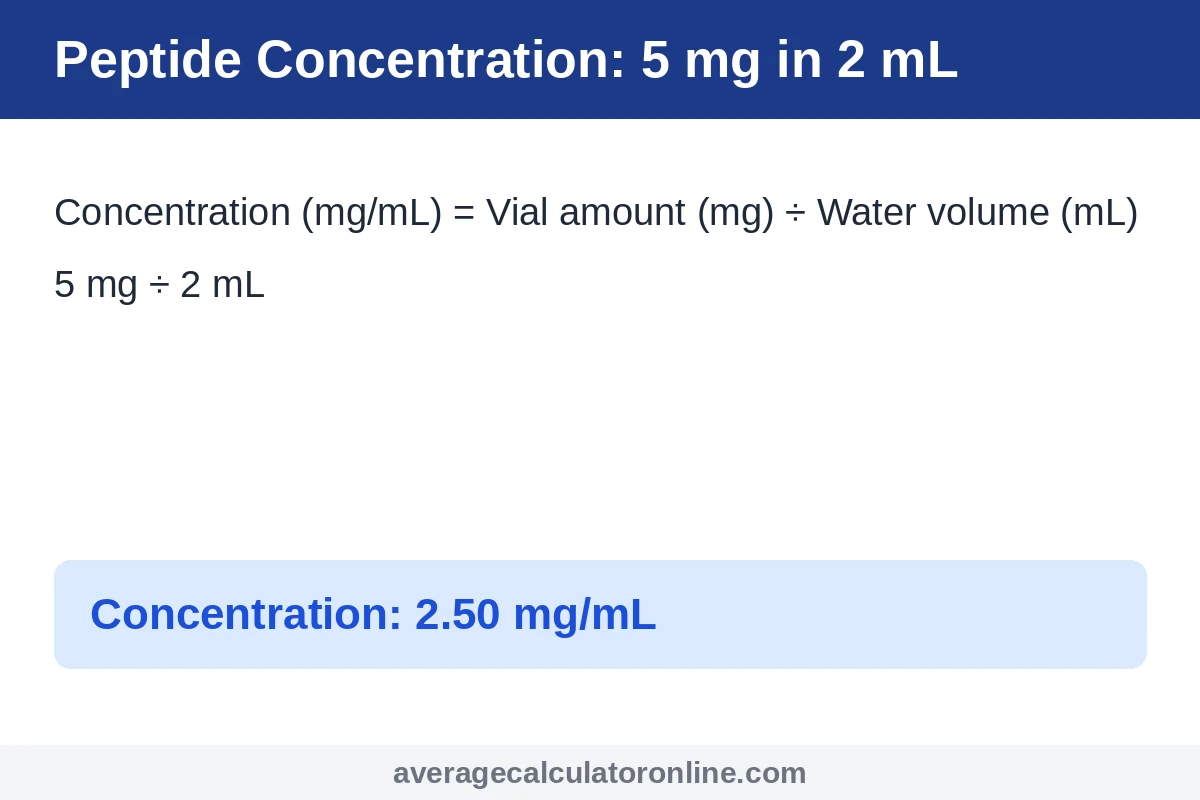
Concentration (mg/mL) = Vial amount (mg) ÷ Water volume (mL)
Total volume for a target concentration (mL) = Vial amount (mg) ÷ Target concentration (mg/mL)
For example, 5 mg in 2 mL of water gives a concentration of 5 ÷ 2 = 2.50 mg/mL, and diluting 10 mg to a target concentration of 2.00 mg/mL needs a total volume of 10 ÷ 2.00 = 5.00 mL. Enter your own numbers below and the tool works out the concentration for you.
The tool
Peptide Calculator
Educational tool only — not medical advice. This page is general concentration maths only and is not for preparing injectables or working out an injection dose. Never use peptides without a qualified healthcare professional.
Defaults on load: 5 mg in 2 mL → 2.50 mg/mL concentration. The result shows as soon as the page loads, before you enter anything.
How it works
- Find the concentration. Divide the vial amount in milligrams by the water volume in millilitres: concentration (mg/mL) = vial amount (mg) ÷ water volume (mL). With 5 mg in 2 mL, that is 5 ÷ 2 = 2.50 mg/mL. The concentration tells you how many milligrams are in each millilitre.
- Work out a dilution volume. To reach a target concentration, divide the vial amount by the target concentration: total volume (mL) = vial amount (mg) ÷ target concentration (mg/mL). For 10 mg at a target of 2.00 mg/mL, that is 10 ÷ 2.00 = 5.00 mL of total solution.
- Check the units. Milligrams (mg) measure an amount; millilitres (mL) measure a volume. The formula only works when the units match — mg with mL, or mcg converted to mg first (see the conversion table below). Never divide milligrams by millilitres and read the answer in the wrong unit.
Concentration table
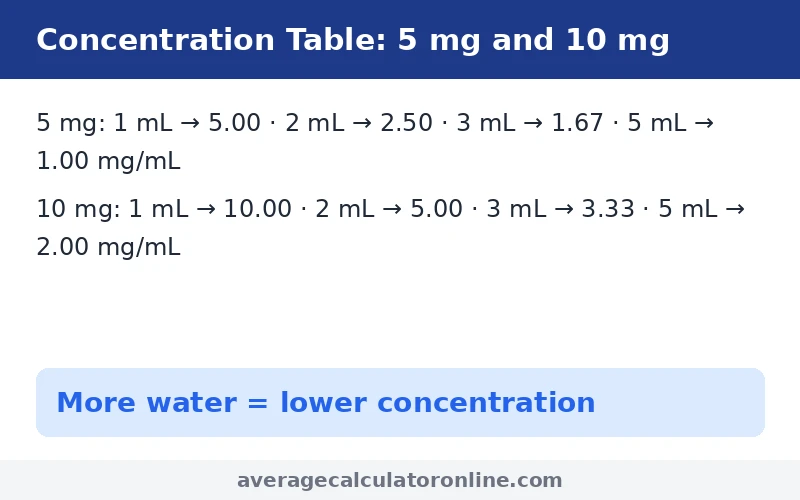
Concentration in mg/mL for common vial and water combinations:
| Vial amount (mg) | Water 1 mL | Water 2 mL | Water 3 mL | Water 5 mL |
|---|---|---|---|---|
| 5 | 5.00 | 2.50 | 1.67 | 1.00 |
| 10 | 10.00 | 5.00 | 3.33 | 2.00 |
The pattern is pure division: the same vial amount divided by more water always gives a lower concentration. 5 mg in 1 mL is 5.00 mg/mL; the same 5 mg in 5 mL is 1.00 mg/mL.
Dilution table: total volume for a target concentration
Total solution volume in mL needed to reach each target concentration:
| Target concentration (mg/mL) | Total volume for 5 mg (mL) | Total volume for 10 mg (mL) |
|---|---|---|
| 1.00 | 5.00 | 10.00 |
| 2.50 | 2.00 | 4.00 |
| 5.00 | 1.00 | 2.00 |
| 10.00 | 0.50 | 1.00 |
At a higher target concentration the total volume is smaller: 10 mg diluted to 1.00 mg/mL needs 10.00 mL of total solution, while the same 10 mg at 5.00 mg/mL needs only 2.00 mL.
mg to mcg conversion
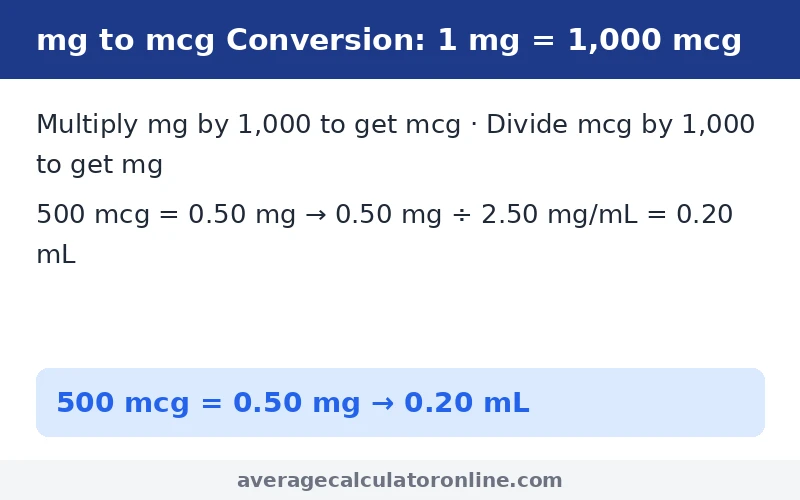
1 mg = 1,000 mcg. Multiply milligrams by 1,000 to get micrograms; divide micrograms by 1,000 to get milligrams.
| mg | mcg |
|---|---|
| 0.25 | 250 |
| 0.50 | 500 |
| 1.00 | 1,000 |
| 2.00 | 2,000 |
Worked examples
Example 1 — The defaults: 5 mg in 2 mL
Vial amount 5 mg, water volume 2 mL.
- Concentration: 5 ÷ 2 = 2.50 mg/mL
- Dilution: to reach a target concentration of 1.00 mg/mL, the total volume is 5 ÷ 1.00 = 5.00 mL
Example 2 — A larger water volume: 10 mg in 5 mL
Vial amount 10 mg, water volume 5 mL.
- Concentration: 10 ÷ 5 = 2.00 mg/mL
- Dilution: to reach a target concentration of 1.00 mg/mL, the total volume is 10 ÷ 1.00 = 10.00 mL
- For comparison, at a target concentration of 5.00 mg/mL the total volume is 10 ÷ 5.00 = 2.00 mL
Example 3 — A small water volume: 10 mg in 1 mL
Vial amount 10 mg, water volume 1 mL.
- Concentration: 10 ÷ 1 = 10.00 mg/mL
- Dilution: to reach a target concentration of 2.00 mg/mL, the total volume is 10 ÷ 2.00 = 5.00 mL
- For comparison, at a target concentration of 5.00 mg/mL the total volume is 10 ÷ 5.00 = 2.00 mL
Example 4 — Working from micrograms: 500 mcg in 2 mL
500 mcg converted to milligrams, then divided by the water volume.
- Convert: 500 ÷ 1,000 = 0.50 mg
- Concentration: 0.50 ÷ 2 = 0.25 mg/mL
- Check: 250 mcg = 0.25 mg in 1 mL, and 0.25 ÷ 1 = 0.25 mg/mL
Tips and mistakes
- Do not mix up mg and mL. Milligrams are an amount; millilitres are a volume. Dividing the wrong way round (water ÷ vial instead of vial ÷ water) gives a meaningless number — always check the units in the answer: concentration must come out in mg/mL.
- Keep the units the same on both sides. If the vial amount is in mcg, convert first (divide mcg by 1,000) to get milligrams before dividing by the water volume in mL.
- More water means a lower concentration, not a higher one. The vial amount is fixed, so a bigger divisor gives a smaller result: 5 mg in 5 mL (1.00 mg/mL) is weaker per millilitre than 5 mg in 1 mL (5.00 mg/mL).
- Round only at the end. Intermediate rounding changes the final result: 5 ÷ 3 = 1.6667 mg/mL, and rounding it to 1.67 before using it in a dilution calculation gives a slightly different total volume than using the full value. Let the tool carry the full precision and round the displayed result.
- Double-check the decimal point. 2.50 mg/mL and 25.0 mg/mL differ by a factor of 10 — the most common arithmetic slip in this kind of calculation is a misplaced decimal, so re-read the result before trusting it.
Sources
Concentration and dilution use the standard dilution equation (C₁V₁ = C₂V₂) — see Dilution (equation) on Wikipedia. Reviewed by the Average Calculator Team. Last reviewed: 7 November 2026.
Frequently asked questions
How do you calculate peptide concentration?
Divide the vial amount in milligrams by the water volume in millilitres: concentration (mg/mL) = vial amount (mg) ÷ water volume (mL). For example, 5 mg in 2 mL is 5 ÷ 2 = 2.50 mg/mL.
How do I work out the dilution volume for a target concentration?
Divide the vial amount in milligrams by the target concentration in mg/mL: total volume (mL) = vial amount (mg) ÷ target concentration (mg/mL). For example, 10 mg at a target of 2.00 mg/mL needs a total volume of 10 ÷ 2.00 = 5.00 mL.
How do I convert mg to mcg?
1 mg = 1,000 mcg. Multiply milligrams by 1,000 to get micrograms, or divide micrograms by 1,000 to get milligrams. For example, 0.5 mg = 500 mcg and 250 mcg = 0.25 mg.
What happens to the concentration if I add more water?
The concentration goes down, because the same vial amount is divided by a larger water volume. For example, 5 mg in 1 mL is 5.00 mg/mL, but the same 5 mg in 5 mL is 5 ÷ 5 = 1.00 mg/mL.
Why does the total volume change when the target concentration changes?
The total volume depends on the target concentration: total volume = vial amount ÷ target concentration. The same 10 mg needs 10.00 mL of total solution at 1.00 mg/mL but only 2.00 mL at 5.00 mg/mL, because a higher target concentration packs more milligrams into each millilitre.
What is the difference between mg and mL?
Milligrams (mg) measure an amount (mass) and millilitres (mL) measure a volume (liquid). Concentration in mg/mL is the link between them: it tells you how many milligrams are in each millilitre, which is why the formula divides mg by mL.
Disclaimer
Educational tool only — not medical advice. Never use peptides without a qualified healthcare professional.
This page is general concentration maths only: it divides the numbers you enter and shows the arithmetic. It is not for preparing injectables and not for working out an injection dose. It does not recommend any amount, schedule, product or use, and it is not a substitute for advice from a qualified healthcare professional. If you have any health question, speak to a qualified healthcare professional.
Related calculators
- Average Calculator Online — the homepage average tool
- BMI Calculator — body mass index from height and weight
- Percentage Calculator — percentage and ratio arithmetic used in the tables above
- Volume Calculator — volume and unit conversions
- Protein Calculator — daily protein amounts by body weight and goal
Last updated: November 7, 2026.