
Date Calculator
Date Calculator
Direct answer
The number of days between two dates is the count of calendar days from the start date to the end date.
Planning around winter weather? See our Snow Day Calculator for the chance school closes for snow.
Days between = End date − Start date
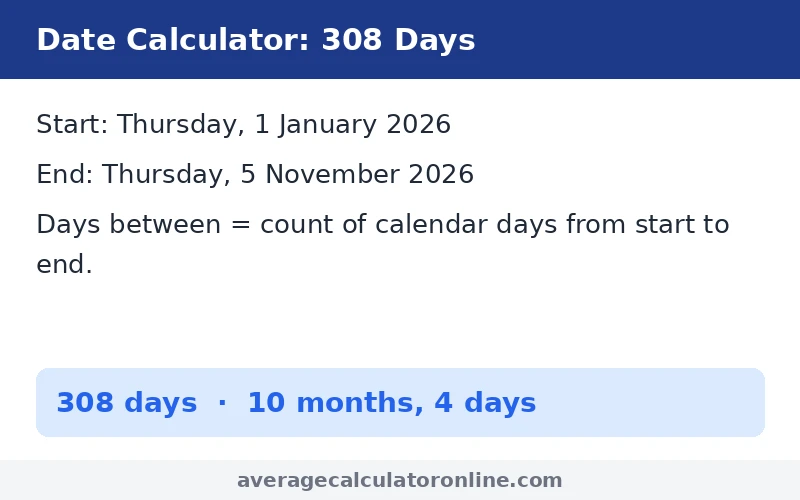
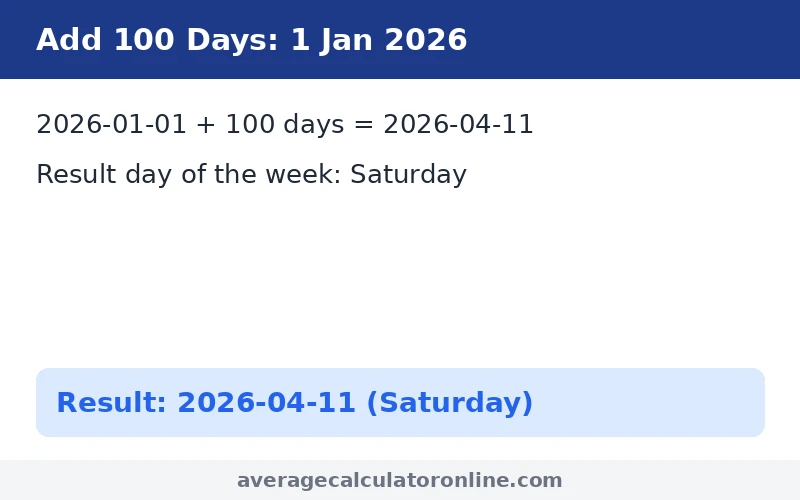
From 1 January 2026 to 5 November 2026 that is 308 days — exactly 44 weeks, or 10 months and 4 days. Both dates fall on a Thursday. Enter your own two dates below and the tool does the same count for you, plus the weeks breakdown, the months/years breakdown, and the weekday of each date. It can also add or subtract a number of days from a start date — for example, 1 January 2026 + 100 days = 11 April 2026, a Saturday.
The tool
Mode 1 — Days between two dates
| Field | Default |
|---|---|
| Start date | 2026-01-01 (Thursday) |
| End date | 2026-11-05 (Thursday) |
Mode 2 — Add / subtract days
| Field | Default |
|---|---|
| Start date | 2026-01-01 (Thursday) |
| Days to add (minus to subtract) | 100 |
Outputs
| Output | Formula | Default result |
|---|---|---|
| Days between | End date − Start date | 308 days |
| Weeks | Days ÷ 7 | 44 weeks and 0 days (44.00 weeks) |
| Months / years | Calendar months between the dates | 0 years, 10 months, 4 days |
| Weekday of each date | Day of the week for each date entered | Thursday and Thursday |
| Result date (add/subtract mode) | Start date ± days | 2026-04-11 (Saturday) |
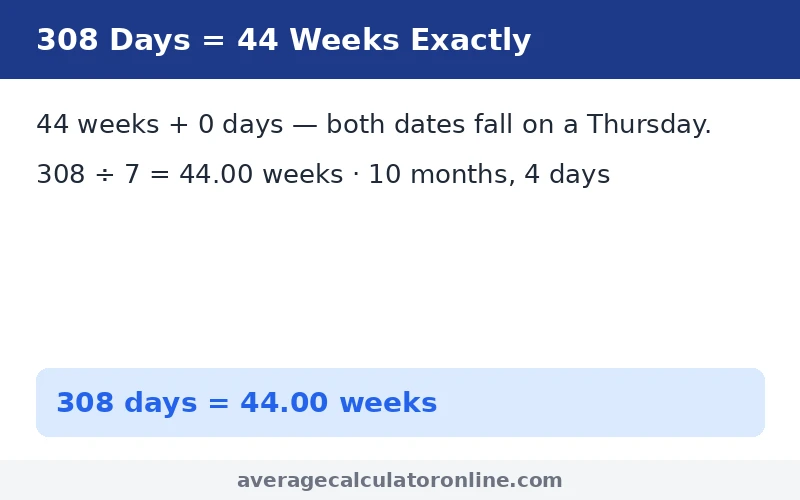
Defaults on load: 2026-01-01 to 2026-11-05 → 308 days. The tool must show this result before the visitor types anything, and must recalculate on every input change.
How it works
- Pick the mode. “Days between two dates” counts the gap between a start and an end date. “Add / subtract days” takes one start date and a number of days and returns the resulting date.
- Count the days. The tool subtracts the start date from the end date in calendar days. The count runs from the start date up to, but not including, the end date — so the result is the number of days you have to move forward to reach the end date.
- Read the breakdowns. The same gap is also shown in weeks (days ÷ 7), in calendar months and years, and with the weekday of each date, so you can see at a glance whether the gap is an exact number of weeks.
- Add or subtract. In the second mode the tool adds the number of days to the start date (or subtracts it when the number is negative) and reports the resulting date and its weekday.
Days between common date pairs
| From | To | Days | Weeks | Months / years |
|---|---|---|---|---|
| 1 Jan 2026 | 1 Feb 2026 | 31 | 4 wks, 3 days | 1 month |
| 1 Jan 2026 | 1 Apr 2026 | 90 | 12 wks, 6 days | 3 months |
| 1 Jan 2026 | 1 Jul 2026 | 181 | 25 wks, 6 days | 6 months |
| 1 Jan 2026 | 1 Jan 2027 | 365 | 52 wks, 1 day | 1 year |
| 1 Jun 2026 | 1 Sep 2026 | 92 | 13 wks, 1 day | 3 months |
| 1 Mar 2026 | 31 Mar 2026 | 30 | 4 wks, 2 days | 30 days |
| 1 Jan 2025 | 1 Jan 2026 | 365 | 52 wks, 1 day | 1 year |
| 14 Feb 2026 | 25 Dec 2026 | 314 | 44 wks, 6 days | 10 months, 11 days |
Days in each month, 2026
| Month | Days | Month | Days |
|---|---|---|---|
| January | 31 | July | 31 |
| February | 28 | August | 31 |
| March | 31 | September | 30 |
| April | 30 | October | 31 |
| May | 31 | November | 30 |
| June | 30 | December | 31 |
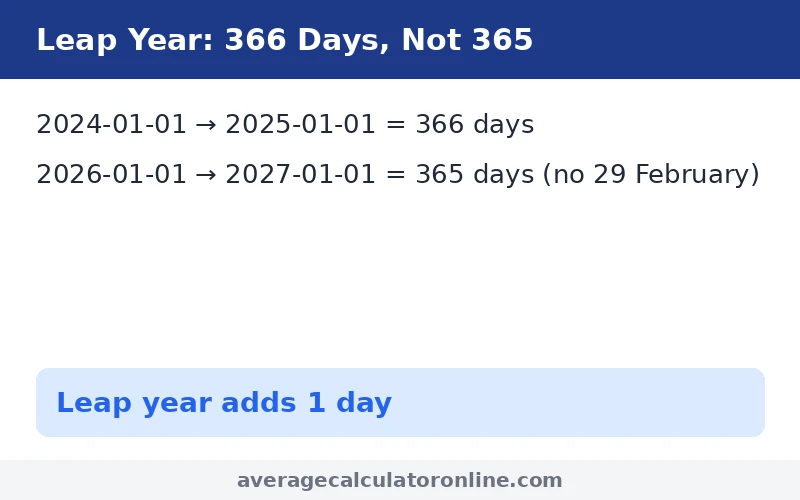
2026 is not a leap year, so February has 28 days and the year has 365 days in total. A leap year such as 2024 has 29 days in February and 366 days in total. The same day-counting idea powers the age calculator, which works out an exact age from a date of birth, and the time calculator, which measures durations in hours and minutes instead of days.
Worked examples
Example 1 — The default: 308 days
1 January 2026 to 5 November 2026.
- 5 Nov 2026 − 1 Jan 2026 = 308 days
- 308 ÷ 7 = 44.00 weeks — exactly 44 weeks and 0 days
- Calendar breakdown: 0 years, 10 months, 4 days
- 1 January 2026 is a Thursday and 5 November 2026 is a Thursday, which is why the gap is an exact number of weeks
Example 2 — A spring-to-summer gap: 97 days
15 March 2026 (Sunday) to 20 June 2026 (Saturday).
- 20 Jun 2026 − 15 Mar 2026 = 97 days
- 97 ÷ 7 = 13.86 weeks — 13 weeks and 6 days
- Calendar breakdown: 0 years, 3 months, 5 days
Example 3 — Adding days: 100 days after New Year’s Day
1 January 2026 + 100 days.
- 1 Jan 2026 + 100 days = 11 April 2026
- 11 April 2026 is a Saturday
- Subtracting instead: 5 November 2026 − 30 days = 6 October 2026, a Tuesday
Example 4 — One week over New Year: 7 days
25 December 2025 (Thursday) to 1 January 2026 (Thursday).
- 1 Jan 2026 − 25 Dec 2025 = 7 days
- 7 ÷ 7 = 1.00 week exactly
- A full year is longer: 1 January 2026 to 1 January 2027 = 365 days (52 weeks, 1 day), while the leap year 2024 gives 1 January 2024 to 1 January 2025 = 366 days
Tips and mistakes
- Do not count both endpoints. The standard day count stops at the end date without including it: 1 January to 5 November 2026 is 308 days, and counting both endpoints gives 309. If your count is one day higher than the tool’s, this is almost always the reason.
- Watch leap years. Any range that includes 29 February gains one extra day. A year starting 1 January 2024 to 1 January 2025 is 366 days, not 365 — check whether February in your range has 28 or 29 days.
- Months are not equal. A “3 months” gap can be 89, 90, 91 or 92 days depending on which months it covers (January to April 2026 is 90 days; June to September 2026 is 92 days). Use the months/years breakdown for calendar months and the day count for exact lengths.
- Weekdays repeat every 7 days. If two dates fall on the same weekday, the gap between them is an exact number of weeks — that is why 1 January and 5 November 2026, both Thursdays, are exactly 44 weeks apart.
- Check the direction. If the end date is earlier than the start date, the tool reports the absolute gap between the two dates. Make sure the earlier date is in the start field.
- Dates, not times. This calculator works with calendar dates only. For hours, minutes and seconds between two moments, use the Time Calculator.
Sources
Day counts use the standard Gregorian calendar and plain date arithmetic — see the NIST Digital Library of Mathematical Functions. Reviewed by the Average Calculator Team. Last reviewed: 7 November 2026.
Frequently asked questions
How many days are between 1 January 2026 and 5 November 2026?
308 days — exactly 44 weeks, or 10 months and 4 days. Both dates fall on a Thursday.
How do you count the days between two dates?
Subtract the start date from the end date: count the calendar days from the start date up to, but not including, the end date. That is the standard day count used by this calculator.
What day of the week is 1 January 2026?
Thursday. 5 November 2026 is also a Thursday, which is why the gap is an exact number of weeks (44).
What date is 100 days after 1 January 2026?
11 April 2026, a Saturday.
Does a leap year change the result?
Yes. A leap year such as 2024 has 366 days, so any range that includes 29 February gains one extra day — for example, 1 January 2024 to 1 January 2025 is 366 days.
Is the end date included in the count?
No. The count stops at the end date without including it: 1 January to 5 November 2026 is 308 days, and including both endpoints would give 309.
Disclaimer
Date arithmetic on this page uses the standard Gregorian calendar: the day count runs from the start date up to, but not including, the end date, and leap years (such as 2024) have 366 days. Results are exact calendar calculations from the dates you enter, not advice. For anything that depends on a deadline — contracts, filings, medical dates or travel — confirm the date with the relevant official source or professional.
Related calculators
- Age Calculator — age from a birth date, the closest related tool
- Time Calculator — hours, minutes and seconds between two moments
- Percentage Calculator — percentage change between two numbers, for example between two day counts
- Scientific Calculator — general arithmetic for date math
- Average Calculator Online — the homepage average tool
Last updated: November 7, 2026.