
LCM Calculator
Direct answer
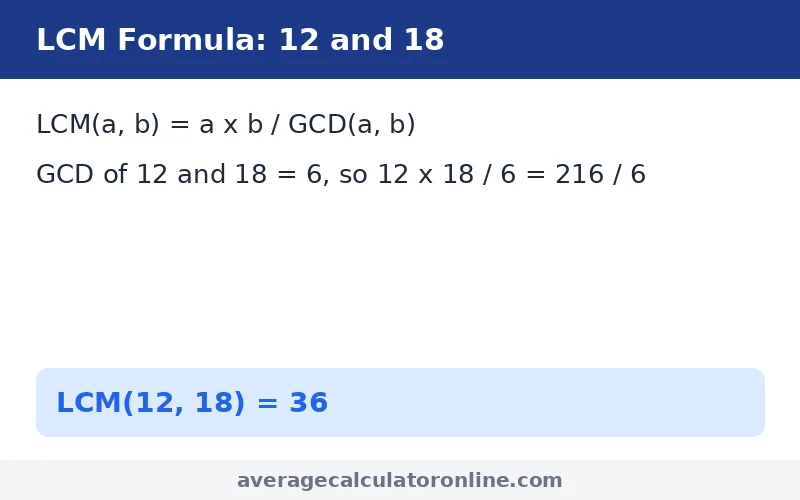
The least common multiple of two numbers is found through their greatest common divisor:
LCM(a, b) = a × b ÷ GCD(a, b)
For the defaults on this page, 12 and 18: the GCD is 6, so LCM(12, 18) = 12 × 18 ÷ 6 = 216 ÷ 6 = 36. Enter your own numbers below and the tool shows the GCD, the LCM, and the step-by-step working.
The tool
LCM Calculator
GCD of 12 and 18: 6
LCM of 12 and 18: 36
Euclidean algorithm for the GCD:
18 = 12 x 1 + 6
12 = 6 x 2 + 0
The last non-zero remainder is the GCD: 6.
LCM formula: LCM = 12 x 18 / GCD = 12 x 18 / 6 = 36.
Multiples of 12: 12, 24, 36
Multiples of 18: 18, 36
The first multiple the two lists share is 36, so that is the least common multiple.
Inputs
| Field | Default |
|---|---|
| First number | 12 |
| Second number | 18 |
| Third number (optional) | blank |
Outputs
| Output | Default result |
|---|---|
| GCD of 12 and 18 | 6 |
| LCM of 12 and 18 | 36 |
| Step-by-step working | Euclidean steps + multiples lists |
Defaults on load: 12 and 18 → GCD 6, LCM 36. The tool must show this result before the visitor types anything, and must recalculate on every input change. Only whole numbers greater than 0 are accepted.
How it works
Method 1 — Through the GCD (Euclidean algorithm)
- Find the GCD with the Euclidean algorithm. Divide the larger number by the smaller one and keep the remainder. Replace the larger number with the smaller one and the smaller one with the remainder, and repeat until the remainder is 0. The last non-zero remainder is the GCD.
- Apply the LCM formula. LCM(a, b) = a × b ÷ GCD(a, b).
- Check the answer. The LCM is always a multiple of both numbers, and it is never smaller than the larger of the two.
For 12 and 18: 18 = 12 × 1 + 6, then 12 = 6 × 2 + 0, so the GCD is 6. Then LCM = 12 × 18 ÷ 6 = 216 ÷ 6 = 36.
Method 2 — Listing multiples
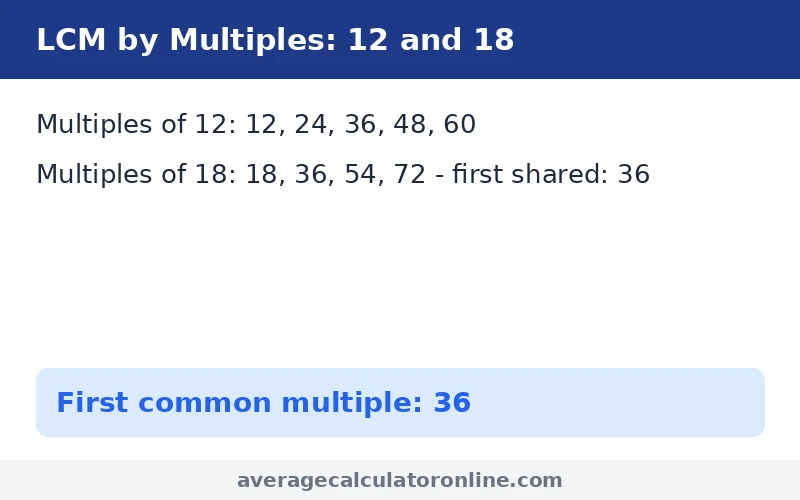
Write out the multiples of each number until a multiple appears in both lists. The first one that appears in both is the least common multiple.
- Multiples of 12: 12, 24, 36, 48, 60
- Multiples of 18: 18, 36, 54, 72
The first shared multiple is 36, so LCM(12, 18) = 36. Listing works well for small numbers; the GCD method is faster for large ones. The GCD step uses the same ideas as the factor calculator, which lists every factor of a number, and the fraction calculator, which simplifies fractions with the same GCD.
Three numbers
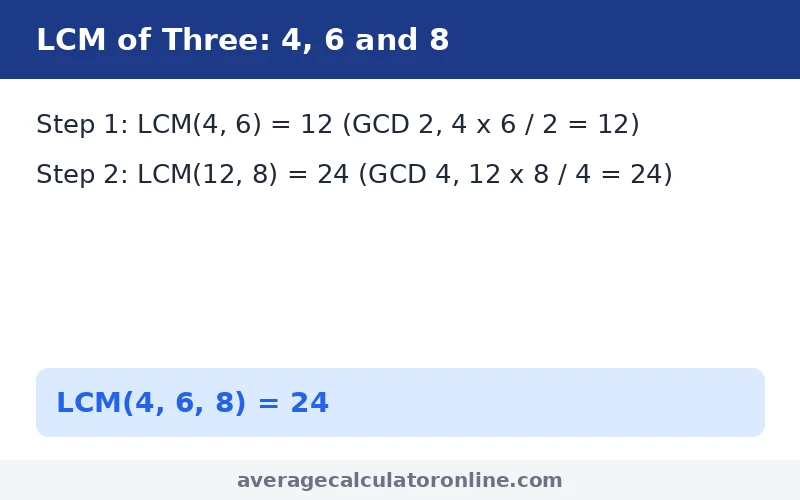
Find the LCM of the first two numbers, then find the LCM of that result with the third number: LCM(a, b, c) = LCM(LCM(a, b), c). For 4, 6 and 8: LCM(4, 6) = 12, then LCM(12, 8) = 24, so LCM(4, 6, 8) = 24.
LCM table for common pairs (recomputed)
| Numbers | GCD | LCM | Check |
|---|---|---|---|
| 4, 6 | 2 | 12 | 4 × 6 ÷ 2 = 12 |
| 6, 8 | 2 | 24 | 6 × 8 ÷ 2 = 24 |
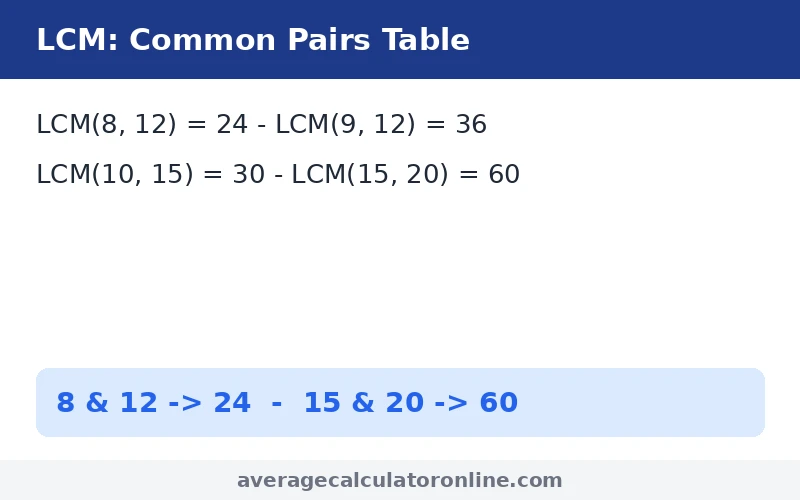
| 8, 12 | 4 | 24 | 8 × 12 ÷ 4 = 24 |
| 9, 12 | 3 | 36 | 9 × 12 ÷ 3 = 36 |
| 10, 15 | 5 | 30 | 10 × 15 ÷ 5 = 30 |
| 12, 18 | 6 | 36 | 12 × 18 ÷ 6 = 36 |
| 5, 7 | 1 | 35 | 5 × 7 ÷ 1 = 35 |
| 14, 21 | 7 | 42 | 14 × 21 ÷ 7 = 42 |
| 15, 20 | 5 | 60 | 15 × 20 ÷ 5 = 60 |
When two numbers share no common divisor except 1, they are coprime and their LCM is simply their product — for example, 5 × 7 = 35.
Worked examples (all recomputed)
Example 1 — The default: LCM(12, 18) = 36
Numbers 12 and 18.
- Euclidean algorithm: 18 = 12 × 1 + 6; 12 = 6 × 2 + 0, so GCD = 6
- LCM = 12 × 18 ÷ 6 = 216 ÷ 6 = 36
- Multiples check: 12, 24, 36 … and 18, 36 … — the first shared multiple is 36
Example 2 — LCM(8, 12) = 24
Numbers 8 and 12.
- Euclidean algorithm: 12 = 8 × 1 + 4; 8 = 4 × 2 + 0, so GCD = 4
- LCM = 8 × 12 ÷ 4 = 96 ÷ 4 = 24
- Multiples check: 8, 16, 24 … and 12, 24 … — the first shared multiple is 24
Example 3 — LCM(15, 20) = 60
Numbers 15 and 20.
- Euclidean algorithm: 20 = 15 × 1 + 5; 15 = 5 × 3 + 0, so GCD = 5
- LCM = 15 × 20 ÷ 5 = 300 ÷ 5 = 60
- Multiples check: 15, 30, 45, 60 … and 20, 40, 60 … — the first shared multiple is 60
Example 4 — Three numbers: LCM(4, 6, 8) = 24
Numbers 4, 6 and 8.
- Step 1: GCD(4, 6) = 2, so LCM(4, 6) = 4 × 6 ÷ 2 = 12
- Step 2: GCD(12, 8) = 4, so LCM(12, 8) = 12 × 8 ÷ 4 = 96 ÷ 4 = 24
- GCD of all three numbers is 2; LCM(4, 6, 8) = 24
Tips and mistakes
- Do not confuse LCM with GCD. The GCD is the largest number that divides both numbers (6 for 12 and 18); the LCM is the smallest number both numbers divide into (36 for 12 and 18). The LCM is always at least as large as the bigger number; the GCD is never larger than the smaller number.
- Use the GCD method for large numbers. Listing multiples of 48 and 36 by hand is slow; the Euclidean algorithm gives GCD 12 in two steps, so LCM = 48 × 36 ÷ 12 = 144.
- Check that the answer is a multiple of both numbers. If your answer is not divisible by both inputs, it is wrong — 36 ÷ 12 = 3 and 36 ÷ 18 = 2, so 36 passes for 12 and 18.
- Do not multiply and stop. a × b is a common multiple, but it is the least one only when the GCD is 1. For 12 and 18, 12 × 18 = 216 is a common multiple, not the least — dividing by the GCD 6 gives the least, 36.
- Enter whole numbers only. LCM is defined for whole numbers; decimals and fractions need a different approach (convert a fraction problem to whole numbers first, or use the Fraction Calculator linked below).
Sources
The least common multiple is standard number theory — see Least Common Multiple on MathWorld. Reviewed by the Average Calculator Team. Last reviewed: 7 November 2026.
Frequently asked questions
What is the LCM?
The least common multiple (LCM) of two or more whole numbers is the smallest whole number that is a multiple of each of them. For example, the multiples of 12 are 12, 24, 36, 48 … and the multiples of 18 are 18, 36, 54 … — the smallest number in both lists is 36, so LCM(12, 18) = 36.
How do you calculate the LCM of two numbers?
Find the GCD first, then use LCM(a, b) = a × b ÷ GCD(a, b). For 12 and 18, the GCD is 6, so LCM = 12 × 18 ÷ 6 = 216 ÷ 6 = 36.
What is the GCD and how does it relate to the LCM?
The GCD (greatest common divisor) is the largest whole number that divides both numbers exactly. It relates to the LCM by the formula LCM(a, b) × GCD(a, b) = a × b. For 12 and 18: GCD 6 × LCM 36 = 216 = 12 × 18.
How do you find the LCM by listing multiples?
Write out the multiples of each number in order until the same number appears in both lists; that first shared number is the LCM. For 8 and 12: multiples of 8 are 8, 16, 24 … and multiples of 12 are 12, 24 … — the first shared multiple is 24.
How do you find the LCM of three numbers?
Find the LCM of the first two numbers, then find the LCM of that result with the third number. For 4, 6 and 8: LCM(4, 6) = 12, then LCM(12, 8) = 24, so LCM(4, 6, 8) = 24.
What is the LCM of 12 and 18?
The LCM of 12 and 18 is 36. The GCD is 6, so 12 × 18 ÷ 6 = 36. You can check it by listing multiples: 12, 24, 36 … and 18, 36 … — 36 is the first multiple they share.
Disclaimer
This calculator works with whole numbers greater than 0 and gives exact results for the numbers you enter. It is an educational maths tool; check school or exam rules for how LCM working should be shown, as required formats vary.
Related calculators
- Average Calculator Online — the homepage average tool
- Fraction Calculator — fraction maths, where LCM is used to find common denominators
- Scientific Calculator — general scientific maths
- Percentage Calculator — percentage calculations
- Grade Calculator — grade averages and scores
Last updated: November 7, 2026.