
Math Calculator
Direct answer
A math calculator does the four basic operations — add, subtract, multiply and divide:
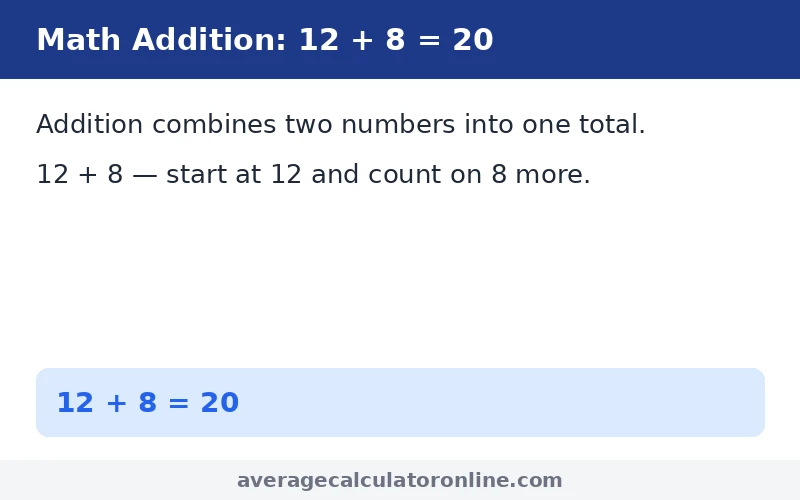
- Addition: 12 + 8 = 20
- Subtraction: 25 − 13 = 12
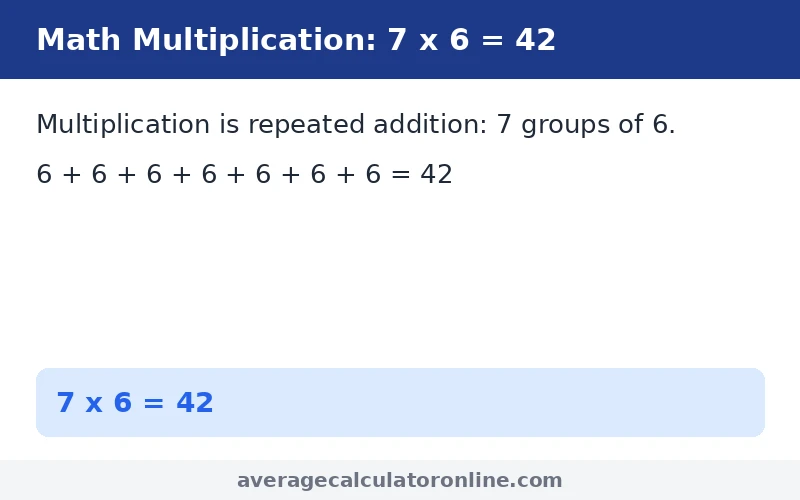
- Multiplication: 7 × 6 = 42
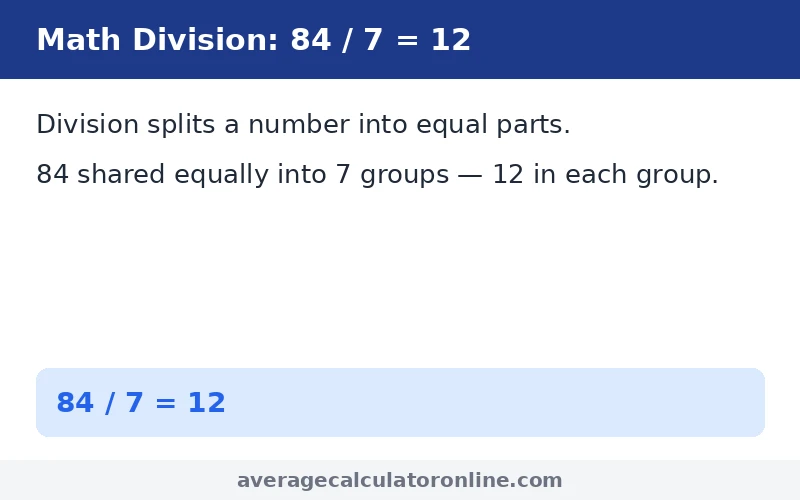
- Division: 84 ÷ 7 = 12
Enter your own two numbers below, pick the operation, and the tool shows the full expression and the result. The default on load is 12 + 8 = 20.
Math Calculator
Inputs
| Field | Default |
|---|---|
| First number | 12 |
| Operation | Add (+) |
| Second number | 8 |
Outputs
| Output | Default result |
|---|---|
| Full expression and result | Addition: 12 + 8 = 20 |
Defaults on load: 12, Add, 8 → 12 + 8 = 20. The tool shows this result before you type anything, and recalculates on every input change. Division by zero shows the message “Cannot divide by zero.” — never Infinity or NaN.
How it works
- Pick the operation. Addition (+) combines, subtraction (−) takes away, multiplication (×) is repeated addition, and division (÷) splits into equal parts.
- Enter two numbers. The tool uses exactly the numbers you type — whole numbers and decimals both work (for example, 12.5 + 8.25 = 20.75).
- Read the full expression. The result line always shows the whole calculation, for example “Multiplication: 7 × 6 = 42”, so you can check the inputs as well as the answer.
Order of operations (BODMAS / PEMDAS)
When a calculation has more than one operation, do them in this order: Brackets first, then Orders (powers), then Division and Multiplication (left to right), then Addition and Subtraction (left to right). PEMDAS is the same rule with American names: Parentheses, Exponents, Multiplication, Division, Addition, Subtraction.
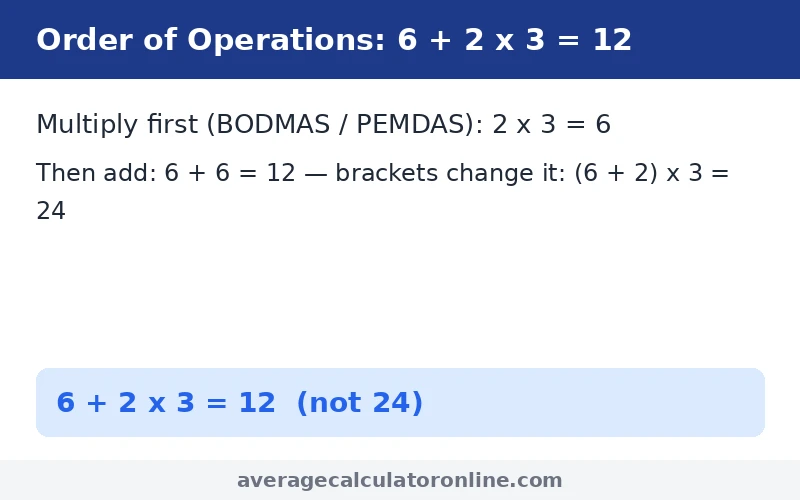
Example: 6 + 2 × 3 = 12, because multiplication comes first — 2 × 3 = 6, then 6 + 6 = 12. Working left to right instead would give the wrong answer, 24. The same order of operations applies when you work with parts of a whole: the percentage calculator handles percent problems, and the fraction calculator adds, subtracts, multiplies and divides fractions step by step. Brackets change the order: (6 + 2) × 3 = 24, because the brackets are done first — 6 + 2 = 8, then 8 × 3 = 24.
Operation symbols and meanings
| Operation | Symbol | Meaning | Example |
|---|---|---|---|
| Addition | + | Combine two numbers into a total | 12 + 8 = 20 |
| Subtraction | − | Take the second number away from the first | 25 − 13 = 12 |
| Multiplication | × | Add a number to itself a number of times | 7 × 6 = 42 |
| Division | ÷ | Split the first number into equal parts | 84 ÷ 7 = 12 |
Times-table reference for the default example (8 times table)
The default calculation is 12 + 8 = 20. The number 8 also appears in the 8 times table, which is useful for checking multiplication by 8:
| × | 1 | 2 | 3 | 4 | 5 | 6 | 7 | 8 | 9 | 10 |
|---|---|---|---|---|---|---|---|---|---|---|
| 8 × | 8 | 16 | 24 | 32 | 40 | 48 | 56 | 64 | 72 | 80 |
Worked examples (all recomputed)
Example 1 — Addition (the default): 12 + 8 = 20
- 12 + 8 = 20
- Check by counting on: 12, then 8 more — 13, 14, 15, 16, 17, 18, 19, 20.
- Check by subtraction: 20 − 8 = 12, which is the first number back.
Example 2 — Subtraction: 25 − 13 = 12
- 25 − 13 = 12
- Check by addition: 12 + 13 = 25, which is the starting number back.
Example 3 — Multiplication: 7 × 6 = 42
- 7 × 6 = 42
- As repeated addition: 6 + 6 + 6 + 6 + 6 + 6 + 6 = 42
- Check by division: 42 ÷ 7 = 6, which is the second number back.
Example 4 — Division: 84 ÷ 7 = 12
- 84 ÷ 7 = 12
- Check by multiplication: 12 × 7 = 84, which is the starting number back.
- A second division check: 100 ÷ 4 = 25.
Tips and mistakes
- Do the multiplication and division before addition and subtraction. 6 + 2 × 3 is 12, not 24 — see the order-of-operations section above.
- Never divide by zero. 12 ÷ 0 has no answer. The tool says so plainly instead of showing Infinity; change the second number to anything except 0.
- Check a subtraction with addition, and a division with multiplication. If 25 − 13 = 12, then 12 + 13 must be 25. If 84 ÷ 7 = 12, then 12 × 7 must be 84.
- Keep the decimal point lined up. 12.5 + 8.25 = 20.75 — adding 12.5 + 8.25 as if they were 125 + 825 gives the wrong answer.
- Watch the order in subtraction and division. 25 − 13 = 12, but 13 − 25 = −12; 84 ÷ 7 = 12, but 7 ÷ 84 = 0.08. Swapping the numbers changes the answer, unlike addition and multiplication.
Sources
Arithmetic follows standard definitions — see the NIST Digital Library of Mathematical Functions. Reviewed by the Average Calculator Team. Last reviewed: 7 November 2026.
FAQs
How do you add two numbers?
Add the second number to the first: the sum is the total of both numbers. For example, 12 + 8 = 20. Enter both numbers in the tool above, choose Add (+), and it shows the full expression and the result.
How do you subtract one number from another?
Take the second number away from the first: the difference is what is left. For example, 25 − 13 = 12. Check it by adding: 12 + 13 = 25, which is the starting number back.
What is 12 plus 8?
12 plus 8 equals 20. That is the default calculation on this page: the tool loads with 12, Add (+), and 8, and shows “Addition: 12 + 8 = 20” before you type anything.
How do you multiply two numbers?
Multiply the first number by the second: multiplication is repeated addition. For example, 7 × 6 = 42, which is 6 added to itself 7 times. Check it by dividing: 42 ÷ 7 = 6.
How do you divide one number by another?
Split the first number into equal parts of the second number’s size. For example, 84 ÷ 7 = 12, because 7 groups of 12 make 84. You cannot divide by zero — the tool shows “Cannot divide by zero.” instead of an answer.
What is the order of operations (BODMAS / PEMDAS)?
Do brackets first, then powers, then multiplication and division from left to right, then addition and subtraction from left to right. For example, 6 + 2 × 3 = 12, because 2 × 3 = 6 is done first and then 6 + 6 = 12. Brackets change the order: (6 + 2) × 3 = 24.
Disclaimer
Results depend on the numbers you enter. This page is an educational arithmetic tool for everyday calculations; double-check the result before using it for anything important, such as money, measurements or schoolwork submitted for grading.
Related calculators
- Average Calculator Online — the homepage average tool
- Scientific Calculator — powers, roots and trigonometry beyond basic arithmetic
- Percentage Calculator — percentage change and percentages of a number
- Fraction Calculator — add, subtract, multiply and divide fractions
- Volume Calculator — volume of boxes, cylinders and spheres
Last updated: November 7, 2026.