
Average Speed Calculator
Direct answer
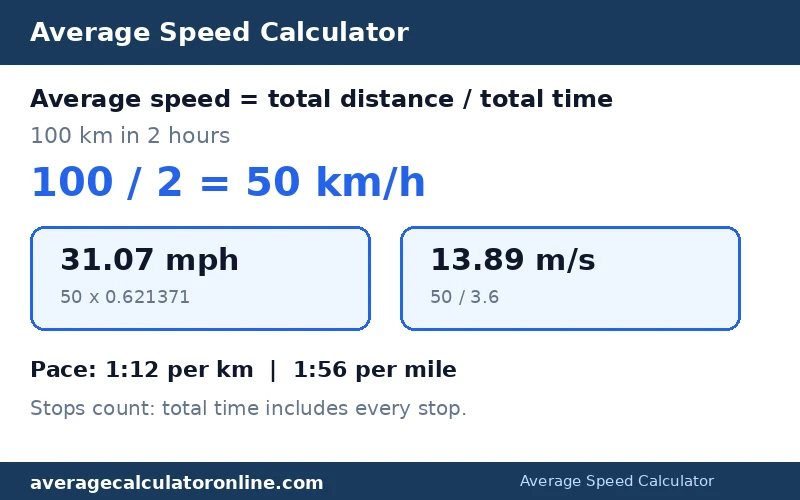
Average speed = Total distance ÷ Total time. The total time includes stops — if you drive 100 km in 2 hours, your average speed is 100 ÷ 2 = 50 km/h, even if you drove faster than 50 km/h for part of the trip and stopped for the rest.
For the default trip of 100 km in 2 hours: the average speed is 50.00 km/h, which is 31.07 mph and 13.89 m/s, with a pace of 1:12 per km and 1:56 per mile. Enter your own distance and time below and the tool converts the result into all three speed units plus pace.
Average Speed Calculator
Inputs
| Field | Default |
|---|---|
| Distance | 100 |
| Distance unit | km (km / miles / meters) |
| Hours | 2 |
| Minutes | 0 |
| Seconds | 0 |
Outputs
| Output | Formula | Default result |
|---|---|---|
| Average speed (km/h) | Distance (km) ÷ Time (h) | 50.00 km/h |
| Average speed (mph) | km/h × 0.621371 | 31.07 mph |
| Average speed (m/s) | km/h ÷ 3.6 | 13.89 m/s |
| Pace per km | 60 ÷ speed (km/h) | 1:12 per km |
| Pace per mile | 60 ÷ speed (mph) | 1:56 per mile |
Defaults on load: 100 km in 2 h → 50.00 km/h, 31.07 mph, 13.89 m/s, pace 1:12/km, 1:56/mile. The tool must show these results before the visitor types anything, and must recalculate on every input change. Distance and time must both be greater than 0; otherwise the tool shows a message instead of a number (never NaN or Infinity).
How it works
- Convert the distance to kilometres. The tool works in kilometres internally. Miles are converted with 1 mile = 1.60934 km, and meters are divided by 1,000. So 26.2 miles becomes 26.2 × 1.60934 = 42.16 km, and 100 meters becomes 0.1 km.
- Convert the time to hours. Hours stay as they are, minutes are divided by 60 and seconds by 3,600. So 3 hours 30 minutes becomes 3 + 30 ÷ 60 = 3.5 hours, and 9.58 seconds becomes 9.58 ÷ 3,600 = 0.002661 hours.
- Divide distance by time. Average speed = Total distance ÷ Total time. For the default trip: 100 km ÷ 2 h = 50.00 km/h.
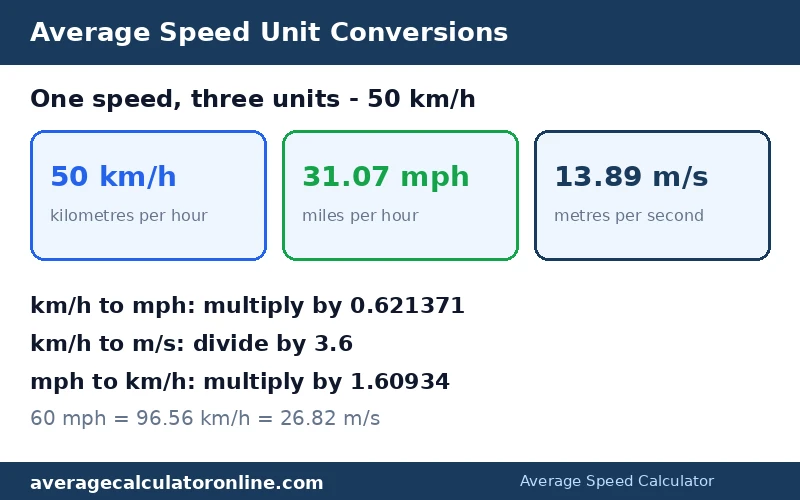
- Convert to the other units. km/h to mph: multiply by 0.621371 (50 × 0.621371 = 31.07 mph). km/h to m/s: divide by 3.6 (50 ÷ 3.6 = 13.89 m/s).
- Work out the pace. Pace is time per unit of distance — the inverse of speed. Pace per km = 60 ÷ speed in km/h: 60 ÷ 50 = 1.20 minutes = 1:12 per km. Pace per mile = 60 ÷ speed in mph: 60 ÷ 31.07 = 1.93 minutes = 1:56 per mile.
Average speed is not top speed
Average speed divides the whole distance by the whole time, including stops, traffic lights and slow stretches. If you drive 100 km in 2 hours, your average speed is 50 km/h even if your speedometer showed 90 km/h on the motorway and 0 km/h at a petrol stop. Your top speed (the fastest you went at any moment) and your cruising speed (the speed you held most of the time) are both different numbers — usually higher than the average.
Unit conversions (km/h, mph, m/s)
| km/h | mph (× 0.621371) | m/s (÷ 3.6) | Pace per km | Pace per mile |
|---|---|---|---|---|
| 10 | 6.21 | 2.78 | 6:00 | 9:39 |
| 12 | 7.46 | 3.33 | 5:00 | 8:03 |
| 12.06 | 7.49 | 3.35 | 4:59 | 8:01 |
| 50 | 31.07 | 13.89 | 1:12 | 1:56 |
| 60 | 37.28 | 16.67 | 1:00 | 1:37 |
| 96.56 | 60.00 | 26.82 | 0:37 | 1:00 |
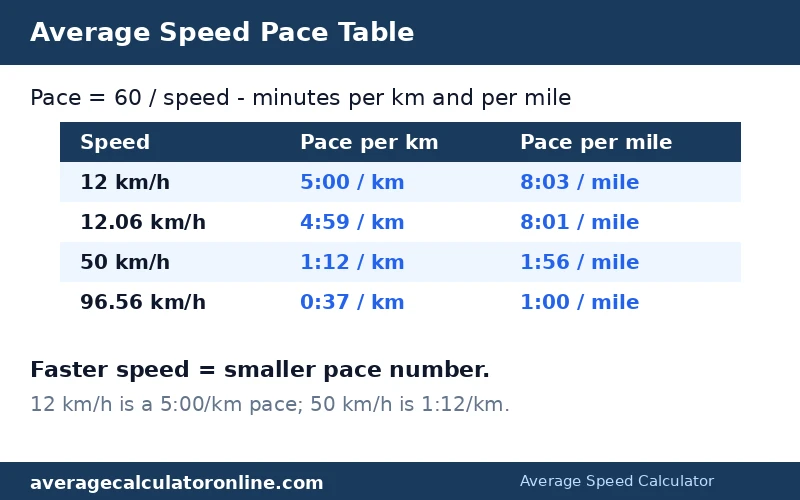
The 12.06 km/h row is the marathon example below; the 96.56 km/h row is 60 miles in 1 hour.
Pace at a glance
| Speed | Pace per km | Pace per mile | Example |
|---|---|---|---|
| 12.00 km/h | 5:00 | 8:03 | 10 km in 50 minutes |
| 12.06 km/h | 4:59 | 8:01 | Marathon in 3 hours 30 minutes |
| 50.00 km/h | 1:12 | 1:56 | 100 km in 2 hours |
| 96.56 km/h | 0:37 | 1:00 | 60 miles in 1 hour |
Worked examples (all recomputed in Python and node)
Example 1 — The default trip: 100 km in 2 hours
- Distance: 100 km, time: 2 h
- Average speed: 100 ÷ 2 = 50.00 km/h
- In mph: 50 × 0.621371 = 31.07 mph
- In m/s: 50 ÷ 3.6 = 13.89 m/s
- Pace per km: 60 ÷ 50 = 1.20 min = 1:12 per km
- Pace per mile: 60 ÷ 31.07 = 1.93 min = 1:56 per mile
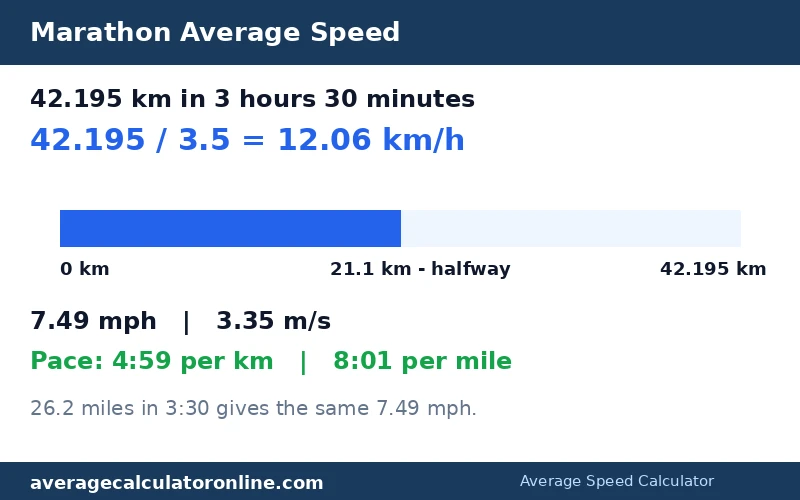
Example 2 — Marathon: 42.195 km in 3 hours 30 minutes
- Distance: 42.195 km, time: 3 h 30 min = 3.5 h
- Average speed: 42.195 ÷ 3.5 = 12.06 km/h
- In mph: 12.06 × 0.621371 = 7.49 mph
- In m/s: 12.06 ÷ 3.6 = 3.35 m/s
- Pace per km: 60 ÷ 12.06 = 4.9769 min = 4:59 per km
- Pace per mile: 60 ÷ 7.49 = 8.01 min = 8:01 per mile
The same marathon entered as 26.2 miles in 3 hours 30 minutes gives the same result: 26.2 miles = 42.16 km, so 42.16 ÷ 3.5 = 12.05 km/h and 7.49 mph, pace 4:59 per km and 8:01 per mile (the tiny 12.06 vs 12.05 difference is rounding: 26.2 miles is 42.1649 km, slightly less than the official 42.195 km).
Example 3 — 10 km run in 50 minutes (and 5 km in 25 minutes)
- Distance: 10 km, time: 50 min = 0.8333 h
- Average speed: 10 ÷ 0.8333 = 12.00 km/h
- In mph: 12 × 0.621371 = 7.46 mph
- In m/s: 12 ÷ 3.6 = 3.33 m/s
- Pace per km: 60 ÷ 12 = 5.00 min = 5:00 per km
- Pace per mile: 60 ÷ 7.46 = 8.05 min = 8:03 per mile
A 5 km run in 25 minutes gives exactly the same speeds and pace (5 ÷ 0.4167 = 12.00 km/h) — halving both the distance and the time leaves the average speed unchanged.
Example 4 — 60 miles in 1 hour
- Distance: 60 miles = 60 × 1.60934 = 96.56 km, time: 1 h
- Average speed: 96.56 ÷ 1 = 96.56 km/h
- In mph: 96.56 × 0.621371 = 60.00 mph
- In m/s: 96.56 ÷ 3.6 = 26.82 m/s
- Pace per km: 60 ÷ 96.56 = 0.62 min = 0:37 per km
- Pace per mile: 60 ÷ 60 = 1.00 min = 1:00 per mile
A short sprint: 100 m in 9.58 seconds
- Distance: 100 m = 0.1 km, time: 9.58 s = 0.002661 h
- Average speed: 0.1 ÷ 0.002661 = 37.58 km/h
- In m/s: 37.58 ÷ 3.6 = 10.44 m/s
- In mph: 37.58 × 0.621371 = 23.35 mph
- 9.58 seconds is the men’s 100 m world-record time, used here only as a worked example of the calculation. Note that this is an average over the whole 100 m, including the standing start — the top speed reached during the sprint was higher.
Tips and mistakes
- Include the stops. Average speed uses total time, including traffic lights, fuel stops and rest breaks. Leaving the stops out gives a higher number that is not the average speed.
- Do not average the speeds. If you drive 60 km/h for one hour and then 40 km/h for one hour, the average speed is (60 + 40) ÷ 2 = 50 km/h — but only because the two stretches lasted the same time. If the times differ, you must divide total distance by total time instead of averaging the two speeds.
- Match the units before dividing. Dividing 100 miles by 2 hours gives 50 mph, not 50 km/h. Convert miles to km (× 1.60934) or km to miles (× 0.621371) first — the tool does this for you when you pick the unit.
- Minutes are not decimals. 3 hours 30 minutes is 3.5 hours, not 3.30 hours. Divide the minutes by 60: 30 ÷ 60 = 0.5.
- Pace and speed are inverses. A faster speed means a smaller pace number. 12 km/h is a 5:00/km pace; doubling the speed to 24 km/h halves the pace to 2:30/km.
- Seconds matter for sprints. For a 100 m sprint, one second changes the result by several km/h, so enter the seconds exactly — the tool accepts decimals such as 9.58.
- Time must be greater than zero. A distance with zero time has no defined average speed — the tool shows a message instead of a number.
Frequently asked questions
How do you calculate average speed?
Divide the total distance by the total time: Average speed = Total distance ÷ Total time. For 100 km in 2 hours, the average speed is 100 ÷ 2 = 50 km/h, which is 31.07 mph and 13.89 m/s.
What is the difference between average speed and top speed?
Average speed is the total distance divided by the total time, including stops, so it describes the whole trip. Top speed is the fastest speed reached at any single moment during the trip, which is usually higher than the average speed.
How do you convert km/h to mph?
Multiply the km/h value by 0.621371. For example, 50 km/h × 0.621371 = 31.07 mph. To convert the other way, multiply mph by 1.60934: 60 mph × 1.60934 = 96.56 km/h.
How do you calculate pace per kilometre?
Divide 60 by the speed in km/h: Pace (min/km) = 60 ÷ speed in km/h. At 50 km/h the pace is 60 ÷ 50 = 1.20 minutes, or 1:12 per km. At 12 km/h the pace is 60 ÷ 12 = 5.00 minutes, or 5:00 per km.
What is a good average speed for a marathon?
A marathon of 42.195 km finished in 3 hours 30 minutes has an average speed of 12.06 km/h (7.49 mph), which is a pace of 4:59 per km or 8:01 per mile. Faster finishers have a higher average speed and a lower (faster) pace; slower finishers have a lower average speed and a higher pace.
Does average speed include stops?
Yes. Average speed is total distance divided by total time, and total time includes every stop — traffic lights, fuel stops, rest breaks and waiting time. If you exclude the stops, you get a higher number that is the average moving speed, not the average speed of the whole trip.
Disclaimer
Average speed on this page is total distance divided by total time, including stops. It is not the same as top speed or cruising speed, which are usually higher. The results are estimates for planning and training only — they are not driving, safety, medical or legal advice. Always follow posted speed limits and local traffic laws; the calculator does not tell you how fast you should drive.
Related calculators
- Average Calculator Online — the homepage average tool
- Distance Calculator — how far you travelled from speed and time
- Time Calculator — how long a trip takes at a given speed
- Math Calculator — hand-check any division or conversion
- Percentage Calculator — percentage change and proportions
Last updated: November 7, 2026.