Understanding Weighted Averages: Formula, Examples & Mistakes
Short answer: a weighted average gives some values more influence than others. Multiply each value by its weight, add the products, and divide by the total weight — the result is pulled toward the biggest weights. Weighted averages are everywhere: course grades where the final counts double, GPAs where a 4-credit course matters more than a 3-credit one, investment returns where your largest holding dominates, and survey ratings where one group is bigger.
This guide gives the formula, works through real examples — grades, a full course, an investment portfolio and a GPA — shows when a simple average fails, and lists the mistakes that most often break the calculation.
The Weighted Average Formula
Weighted average = (sum of value × weight) ÷ (sum of weights)
Weights can be percentages, points, credits, counts or money — any measure of how much each value should count. Two things matter: weights must reflect real importance, and you must divide by the total weight, not by the number of values. Forgetting that division is the most common error.
When every weight is equal, the weighted average is the same as the simple average. The weights only change the answer when values count unequally — which, in grades, money and surveys, is most of the time.
Worked Example 1: Two Scores With Different Weights
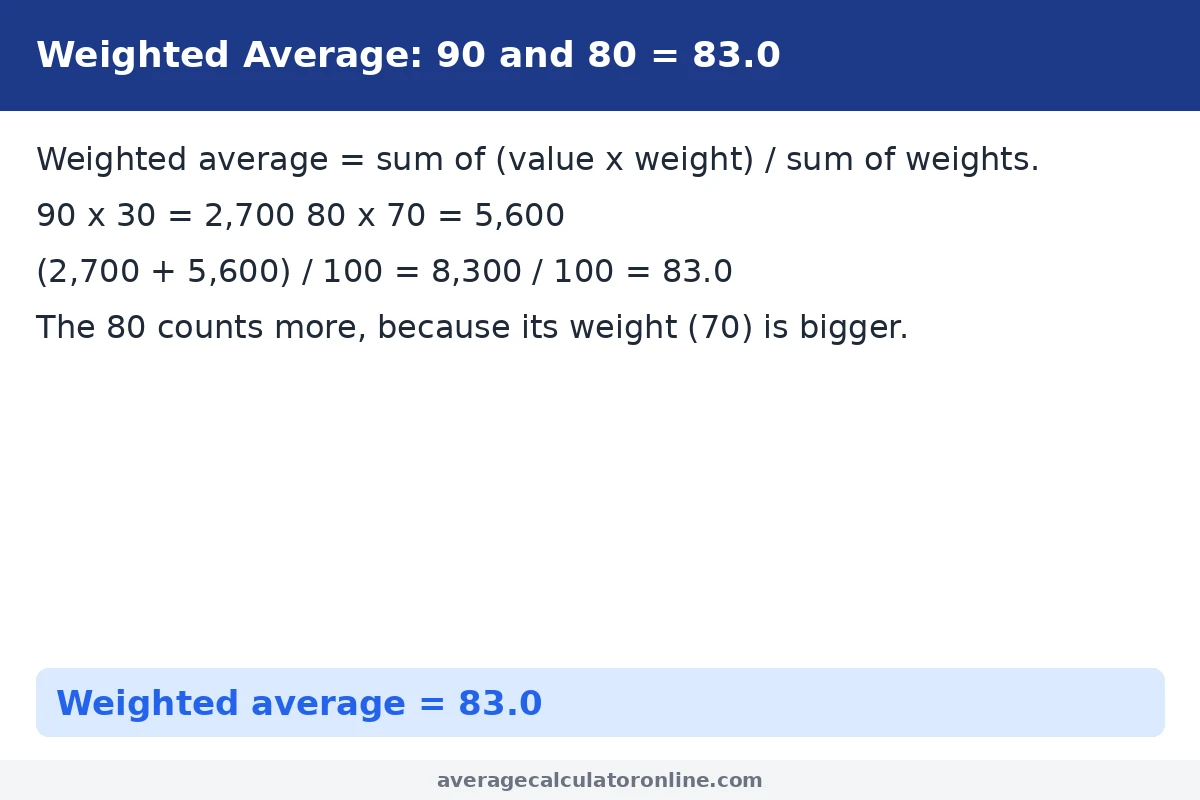
Take 90 with a weight of 30, and 80 with a weight of 70. A simple average gives (90 + 80) ÷ 2 = 85.0, treating both as equals — but the 80 carries more than twice the weight of the 90, so the answer must sit closer to 80.
Step 1 — Multiply each value by its weight: 90 × 30 = 2,700, and 80 × 70 = 5,600.
Step 2 — Add the products: 2,700 + 5,600 = 8,300.
Step 3 — Divide by the total weight: 8,300 ÷ 100 = 83.0.
The weighted average is 83.0, lower than the simple average of 85.0, since the lower score had the bigger weight: weights pull the answer toward the values that matter most. Try it with the Weighted Average Calculator.
Worked Example 2: Three Grades With Weights 3, 2 and 5
Suppose a student scores 88 on a 3-point project, 92 on a 2-point quiz, and 76 on a 5-point test. The weights are points, not percentages, and do not add to 100 — fine, because the formula divides by whatever they add to.
Step 1 — Multiply: 88 × 3 = 264, 92 × 2 = 184, and 76 × 5 = 380.
Step 2 — Add the products: 264 + 184 + 380 = 828.
Step 3 — Add the weights: 3 + 2 + 5 = 10.
Step 4 — Divide: 828 ÷ 10 = 82.8.
The weighted average is 82.8, below the simple average of (88 + 92 + 76) ÷ 3 = 85.3, because the lowest grade, 76, carried the biggest weight (5). When the stakes differ, the average must reflect it — check results like this with the Grade Calculator.
Worked Example 3: A Full Course Grade and a GPA
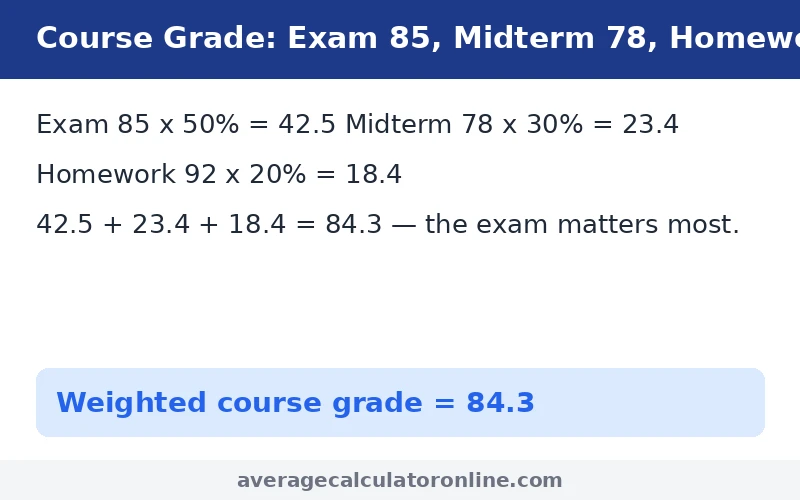
Course grades are the most common weighted averages. Take a course where the exam is worth 50%, the midterm 30% and homework 20%: a student scores 85 on the exam, 78 on the midterm and 92 on homework.
Step 1 — Multiply: exam 85 × 50% = 42.5, midterm 78 × 30% = 23.4, homework 92 × 20% = 18.4.
Step 2 — Add: 42.5 + 23.4 + 18.4 = 84.3.
The weighted course grade is 84.3 — and because the weights add to 100, there is no extra division step. Notice how the exam dominates: homework was the best score (92) but added only 18.4 points, while the exam contributed 42.5. A 10-point drop on the exam costs 5 course points; the same drop in homework costs only 2. Always check each part’s weight before deciding where to study. The Final Grade Calculator answers the reverse question: what exam score reaches a target grade.
A GPA is the same idea with credit hours as weights: an A (4 points) in a 3-credit course, a B (3 points) in a 4-credit course, and another A (4 points) in a 3-credit course.
Step 1 — Multiply: 4 × 3 = 12, 3 × 4 = 12, and 4 × 3 = 12.
Step 2 — Add the products: 12 + 12 + 12 = 36.
Step 3 — Add the credits: 3 + 4 + 3 = 10.
Step 4 — Divide: 36 ÷ 10 = 3.6.
The GPA is 3.6. A simple average, (4 + 3 + 4) ÷ 3 = 3.67, would be slightly wrong: it gives the 4-credit B course the same influence as the 3-credit A courses. For a full semester, use the GPA Calculator.
Worked Example 4: An Investment Portfolio Return
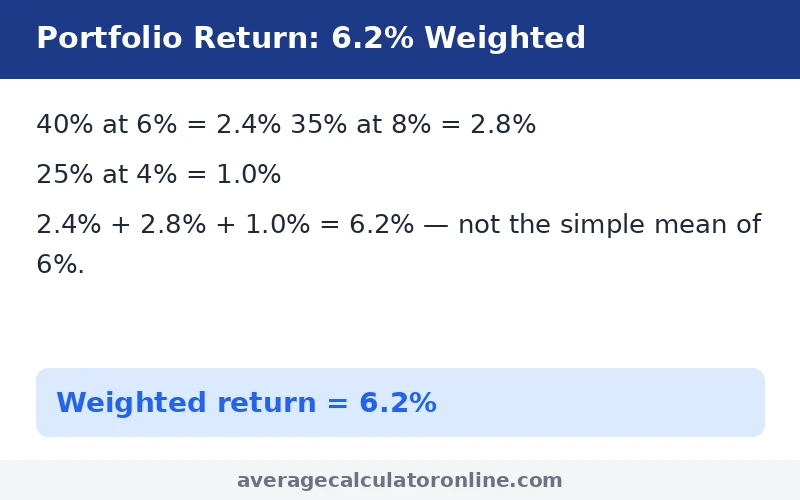
Weighted averages also run your money. Suppose a portfolio holds 40% in a fund returning 6%, 35% in a fund returning 8%, and 25% in a fund returning 4% — the return is not the simple average of 6%, 8% and 4%, because the biggest holding matters most.
Step 1 — Multiply: 40% × 6% = 2.4%, 35% × 8% = 2.8%, and 25% × 4% = 1.0%.
Step 2 — Add: 2.4% + 2.8% + 1.0% = 6.2%.
The weighted portfolio return is 6.2%; the simple average would be (6 + 8 + 4) ÷ 3 = 6.0%, which understates it — the best fund (8%) holds 35% of the money, not a third. On a large portfolio, a 0.2 percentage point error is real money. This is an educational example, not financial advice.
Simple vs Weighted Average on the Same Data
| Data | Simple average | Weighted average | Why they differ |
|---|---|---|---|
| 90 (weight 30), 80 (weight 70) | 85.0 | 83.0 | Lower score has most weight |
| 88 (w3), 92 (w2), 76 (w5) | 85.3 | 82.8 | Lowest grade has biggest weight |
| Exam 85, midterm 78, homework 92 | 85.0 | 84.3 | Exam is half the grade |
| Portfolio: 6%, 8%, 4% | 6.0% | 6.2% | Best fund holds most money |
| GPA: A, B, A (3, 4, 3 credits) | 3.67 | 3.6 | B course has most credits |
The pattern is consistent: the weighted average is pulled toward the value with the biggest weight, and when the weights are equal the two averages agree exactly. When they disagree, the weighted figure is the honest one — provided the weights are right. A weighted average with wrong weights is worse than a simple average, because it looks precise while being wrong.
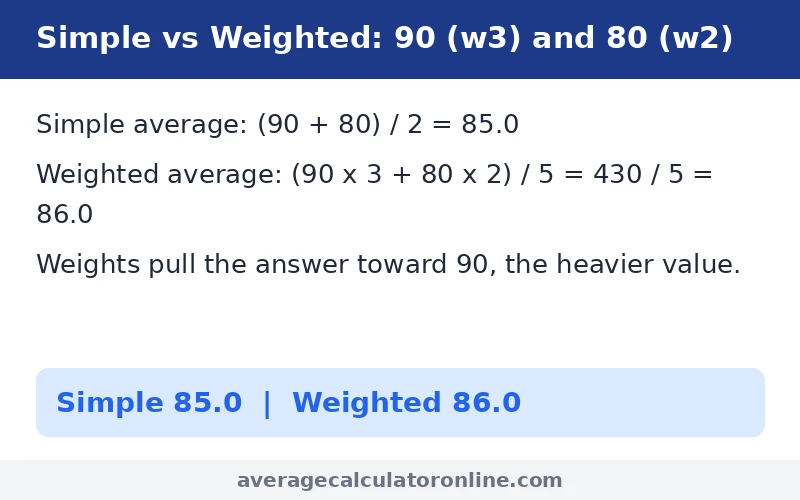
Weights that do not add to 100 need no normalising. Take 90 with weight 3 and 80 with weight 2: 90 × 3 = 270 and 80 × 2 = 160; add the products (430) and divide by the total weight (5): 430 ÷ 5 = 86.0. Scaling the weights to percentages (60% and 40%) gives the same result — a good cross-check.
When You Must Use a Weighted Average
Grades and course marks. Exams, assignments and homework rarely count equally. Use the syllabus weights, and confirm they add to 100%.
GPA. Credit hours are the weights: a 4-credit course moves your GPA more than a 1-credit course, and a simple average of grade points ignores that.
Portfolio returns. Each holding contributes in proportion to the money in it — a small holding with a spectacular return does not make the whole portfolio spectacular.
Survey ratings and review scores. If one product has 500 reviews and another has 10, an average of the two averages is meaningless — weight by the number of ratings, or combine the raw totals.
Any average of averages. This is the big one. Whenever you average numbers that are themselves averages of different-sized groups, weight by group size. Averaging class, monthly or country averages without weights is the most common weighted-average error.
Common Mistakes That Give Wrong Answers
Forgetting to divide by the total weight. Adding value × weight and stopping gives a meaningless large number — in Example 1, 8,300 instead of 83.0. Always finish with the division.
Using percentages that do not add to 100 without normalising. If your weights are 50%, 30% and 30%, they add to 110%, and multiplying straight through overstates the answer. Either fix them to add to 100, or divide by their total (110) at the end.
Averaging percentages directly. A 10% return on a small account and a 2% return on a large account do not average to 6%. Percentages must be weighted by the base they apply to — money, people or time.
Try it: enter your values and weights in the Weighted Average Calculator and compare with the simple average — the gap shows how much the weights matter.
Frequently Asked Questions
What is a weighted average?
An average in which each value counts according to its weight: multiply each value by its weight, add the products, and divide by the total weight. For 90 (weight 30) and 80 (weight 70), the weighted average is 83.0.
What is the formula for a weighted average?
Weighted average = (sum of value × weight) ÷ (sum of weights). Example: (90 × 30 + 80 × 70) ÷ 100 = 8,300 ÷ 100 = 83.0.
How do I calculate a weighted average for grades?
Multiply each grade by its weight, add the results, and divide by the total weight: (264 + 184 + 380) ÷ 10 = 82.8 for grades 88 (weight 3), 92 (weight 2) and 76 (weight 5).
What is the difference between a simple average and a weighted average?
A simple average treats every value equally; a weighted average gives some values more influence. For 90 (weight 3) and 80 (weight 2), the simple average is 85.0 but the weighted average is 86.0.
What if my weights do not add up to 100?
Just divide by the total of your weights. For 90 (weight 3) and 80 (weight 2), the total weight is 5, so the weighted average is (270 + 160) ÷ 5 = 86.0.
How is GPA a weighted average?
Credit hours are weights: an A (4 points) in a 3-credit course, a B (3 points) in a 4-credit course, and an A (4 points) in a 3-credit course give (12 + 12 + 12) ÷ 10 = 3.6.
Related calculators: Weighted Average Calculator · GPA Calculator · Grade Calculator · Final Grade Calculator