Dice Average Explained: Expected Rolls for D4–D20 and More
Short answer: The average roll of a single die is (1 + sides) / 2 — so a d20 averages 10.5, a d6 averages 3.5, and a d4 averages 2.5. For several dice, add the individual averages together: 2d6 averages 7.0, and 1d20+5 averages 15.5. Rolling with advantage on a d20 (take the higher of two dice) averages 13.82, while disadvantage averages 7.17. These are long-run expected values: over hundreds of rolls the results settle close to them.
Dice sit at the heart of tabletop games — Dungeons & Dragons, board games, and countless others — and “what should I expect to roll?” is the question that decides whether a character build, a weapon, or a spell is actually good. The answer is not a feeling; it is arithmetic. This guide works through the formula, the standard dice, and the probabilities behind them, with every number checked. The Dice Average Calculator on this site computes the same expected values for any dice and modifiers you enter.
The Formula: (1 + Sides) / 2
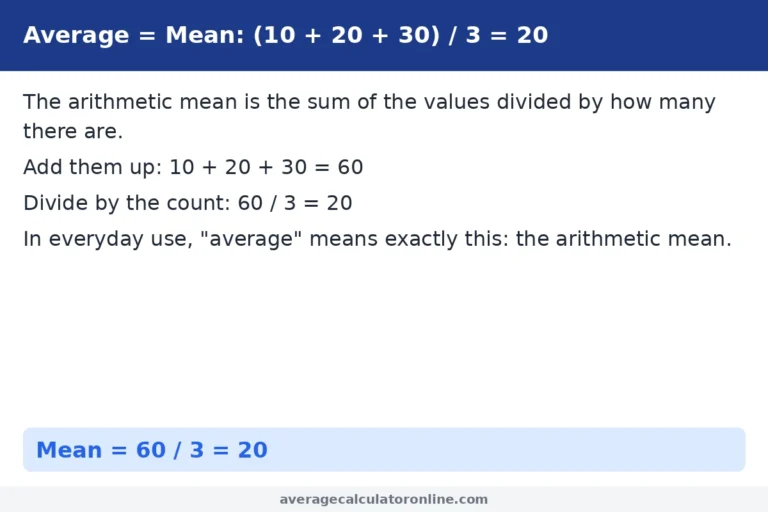
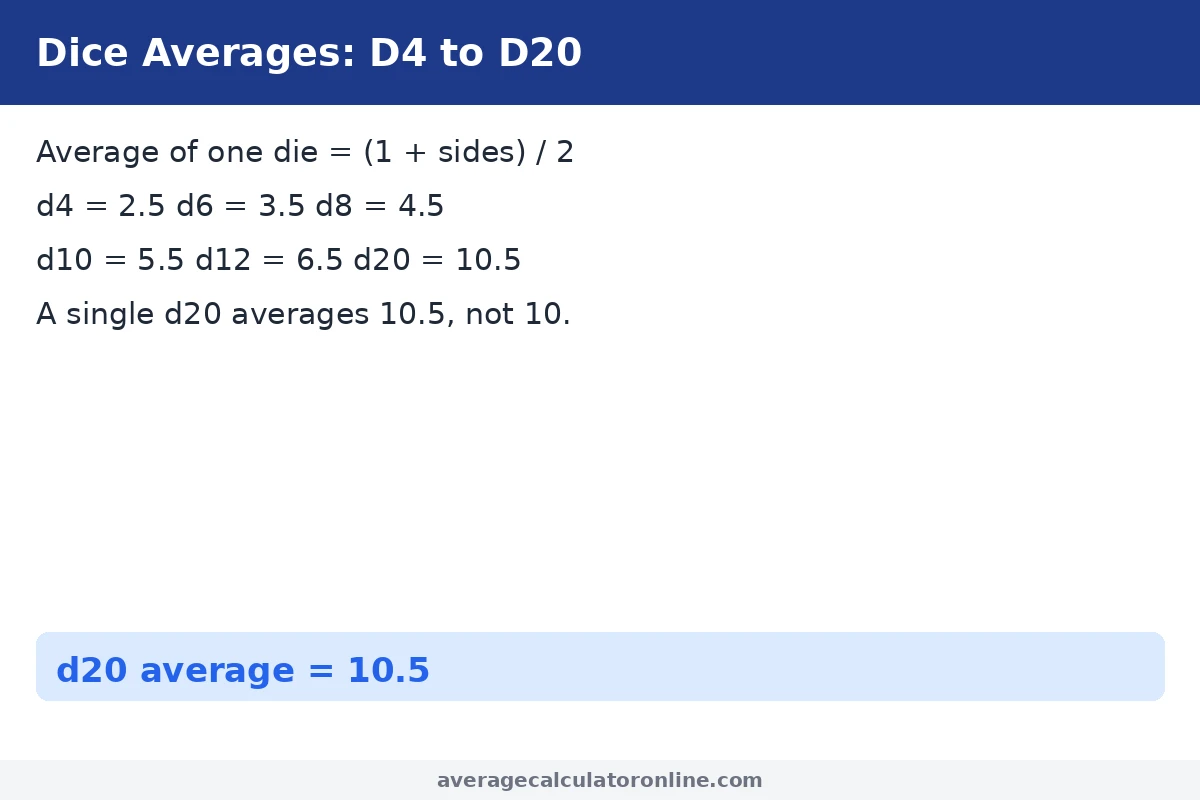
A fair die is equally likely to land on any of its faces. The average roll is therefore the average of all the possible outcomes — the numbers 1 through the number of sides. That average always works out to:
Average of one die = (1 + number of sides) / 2
Why? The outcomes are symmetric around the middle: on a d20, the pairs 1 and 20, 2 and 19, and so on all add up to 21, averaging 10.5.
| Die | Outcomes | Average roll |
|---|---|---|
| d4 | 1–4 | 2.5 |
| d6 | 1–6 | 3.5 |
| d8 | 1–8 | 4.5 |
| d10 | 1–10 | 5.5 |
| d12 | 1–12 | 6.5 |
| d20 | 1–20 | 10.5 |
Two things are worth noticing. First, every average ends in .5, because the number of sides is even and the middle falls between two whole numbers. Second, a d20 “averages” 10.5, not 10 — a small difference that matters when you compare builds over a whole session.
Worked Example 1: 2d6 — Why 7 Is the Most Common Roll
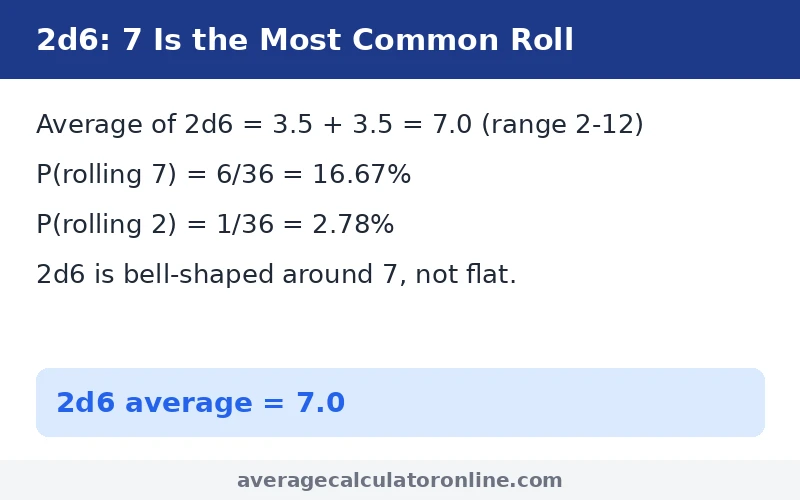
For several dice, averages simply add. Each d6 averages 3.5, so 2d6 averages 3.5 + 3.5 = 7.0, with a range of 2–12.
But the average is only half the story. The distribution of 2d6 is bell-shaped, not flat. There is only one way to roll a 2 (1+1) and only one way to roll a 12 (6+6), but six ways to roll a 7 (1+6, 2+5, 3+4, 4+3, 5+2, 6+1). Out of 36 equally likely pairs:
- Probability of rolling 7: 6 / 36 = 16.67%
- Probability of rolling 2: 1 / 36 = 2.78%
That is why 7 feels like the “normal” result on 2d6 — it genuinely is the most likely single outcome, about six times more likely than a 2. The same logic applies to 3d6, which averages 10.5 (3 × 3.5). Its most extreme result, 18, needs three sixes: 1 / 216 = 0.46%, or roughly once in 216 rolls.
Worked Example 2: Modifiers — 1d20+5 and 2d6+3
A modifier simply shifts the average by the same amount, because it is added after the roll. The rule is: average the dice first, then add the modifier.
- 1d20+5: the d20 averages 10.5, plus 5 gives an average of 15.5, with a range of 6–25.
- 2d6+3: the 2d6 averages 7.0, plus 3 gives an average of 10.0, with a range of 5–15.
Modifiers do not change the spread — they move the whole distribution up or down. A +5 on a d20 is worth exactly 5 points of average on every roll, including the bad ones.
How Spread Out Are the Results? Variance and Standard Deviation
The average tells you the centre; variance and standard deviation tell you how far typical results wander from it. For a single d6, the variance is 2.92 and the standard deviation is 1.71 — a typical roll lands about 1.7 points away from the average of 3.5.
Spread matters when you compare options. A weapon that deals 1d12 (average 6.5) and one that deals 2d6 (average 7.0) look similar, but 2d6 is much more consistent: its results cluster around 7, while 1d12 is equally likely to give 1 or 12. If you need a reliable result, take the dice with the smaller spread; if you want the chance of a huge hit, take the single large die.
Worked Example 3: Advantage and Disadvantage on a d20
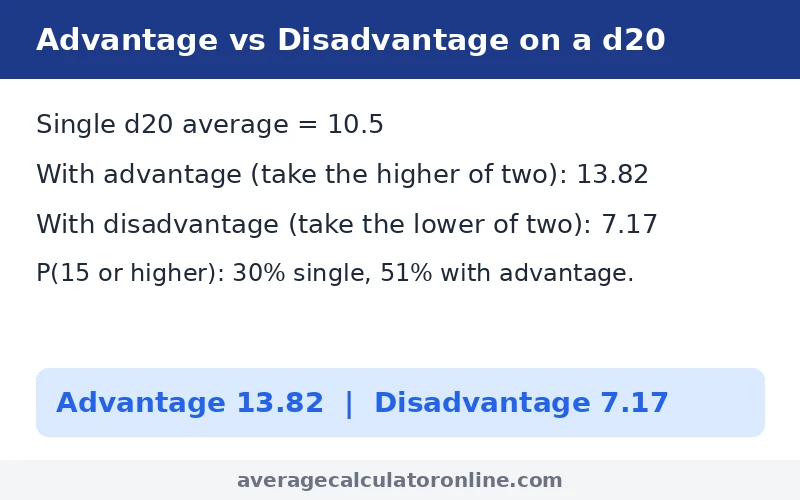
In D&D 5th edition, advantage means rolling two d20s and taking the higher; disadvantage means rolling two and taking the lower. These change the average far more than most players expect:
| Roll type | Average |
|---|---|
| Single d20 | 10.5 |
| Advantage (higher of two d20) | 13.82 |
| Disadvantage (lower of two d20) | 7.17 |
Advantage adds about 3.32 to the average; disadvantage subtracts about 3.33. But the effect is not uniform across the range. Advantage helps most in the middle of the range and least at the extremes — it cannot push a roll above 20, and it rarely turns a 1 into anything good.
The probability of rolling 15 or higher shows the same effect clearly:
- Single d20: 6 outcomes out of 20 (15, 16, 17, 18, 19, 20) = 30%
- With advantage: 1 − (14/20)² = 51%
With advantage, you are more likely than not to roll 15 or higher. That is a large swing from a single mechanic, and it is why advantage is one of the most valuable things a character can gain. For percentage work, the Percentage Calculator can convert any of these fractions for you.
4d6 Drop Lowest: Character Ability Scores
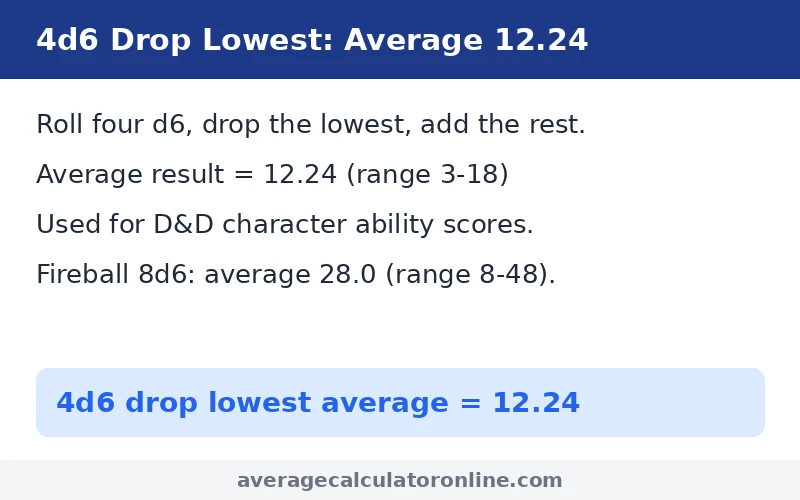
The standard method for generating D&D ability scores is to roll four d6, drop the lowest, and add the other three. What should you expect?
If you rolled 4d6 and added all four, the average would be 14.0 (4 × 3.5). Dropping the lowest die removes, on average, about 1.76 points, giving an average result of 12.24 per ability score, with a range of 3–18.
That average hides an important shape: 4d6 drop lowest is skewed towards higher scores. Scores of 12–15 are common, scores below 8 are rare, and a perfect 18 needs three sixes among the kept dice. Over six ability scores, a typical character totals around 73 (6 × 12.24).
Damage Dice: Fireball and Other Spells
The same addition rule handles damage. A fireball deals 8d6, so its average is 8 × 3.5 = 28.0, with a range of 8–48. Most fireballs land in the 20s or 30s; an 8 or a 48 needs all eight dice to come up the same way.
Comparing spells or weapons is straightforward once you use averages: a 3d6 weapon (average 10.5) beats a 1d12 weapon (average 6.5) by 4 points per hit on average, even though the 1d12 can occasionally roll a 12. Over a long fight, the average is what determines the outcome.
Common Mistakes
Thinking a d20 “averages” 10. It averages 10.5. The outcomes run from 1 to 20, and the middle falls between 10 and 11. The 0.5 matters when you are adding up expected values across many rolls.
Adding modifiers before averaging. Average the dice first, then add the modifier. Averaging the modifier as if it were a die is how errors creep in with mixed dice such as 2d6+1d8+4.
Assuming 2d6 is flat like 1d12. It is not. 1d12 gives every result from 1 to 12 with equal probability (1/12 each). 2d6 gives a bell shape centred on 7, with 7 about twice as likely as 5 or 9, and six times as likely as 2 or 12. The two have different averages (7.0 vs 6.5) and very different behaviour.
Expecting the average on the next roll. Averages describe the long run. After five low rolls in a row, the dice are not “due” a high one — each roll is independent, and the average only asserts itself over hundreds of rolls.
Forgetting that advantage changes the average, not just the odds. Advantage is worth about +3.32 on average, but its value depends on the target number. Against a middling target such as 15, it lifts your chance from 30% to 51%.
Try It
Work out any combination with the Dice Average Calculator — d4 to d100, multiple dice, modifiers, and advantage or disadvantage — or use the Statistics Calculator for the spread of a set of recorded rolls, the Percentage Calculator for hit chances, and the Math Calculator for the arithmetic in between.
Frequently Asked Questions
What is the average roll of a d20?
The average roll of a single d20 is 10.5. The formula is (1 + 20) / 2 = 10.5. The most common mistake is saying 10 — the middle of 1 to 20 falls between 10 and 11.
What is the average of 2d6?
The average of 2d6 is 7.0, with a range of 2–12. Rolling a 7 is the most likely single result, with a probability of 6/36 = 16.67%, while rolling a 2 has a probability of only 1/36 = 2.78%.
How do you calculate the average of dice with a modifier?
Average the dice first, then add the modifier. For 1d20+5, the d20 averages 10.5, so the total averages 15.5. For 2d6+3, the 2d6 averages 7.0, so the total averages 10.0.
What is the average roll with advantage on a d20?
With advantage (roll two d20 and take the higher), the average is 13.82, compared with 10.5 for a single d20. With disadvantage (take the lower), the average is 7.17. The chance of rolling 15 or higher rises from 30% on a single d20 to 51% with advantage.
What is the average of 4d6 drop lowest?
The average of 4d6 drop lowest — roll four six-sided dice, drop the lowest, and add the rest — is 12.24, with a range of 3–18. It is the standard method for generating D&D character ability scores, and it skews towards higher scores than a plain 3d6 roll, which averages 10.5.
What is the average damage of a fireball (8d6)?
A fireball deals 8d6 damage, so its average is 8 × 3.5 = 28.0, with a range of 8–48. Most fireballs land in the 20s or 30s; the extremes of 8 or 48 are possible but rare.
Related calculators: Dice Average Calculator (planned tool — verify live before publishing) · Statistics Calculator · Percentage Calculator · Math Calculator